
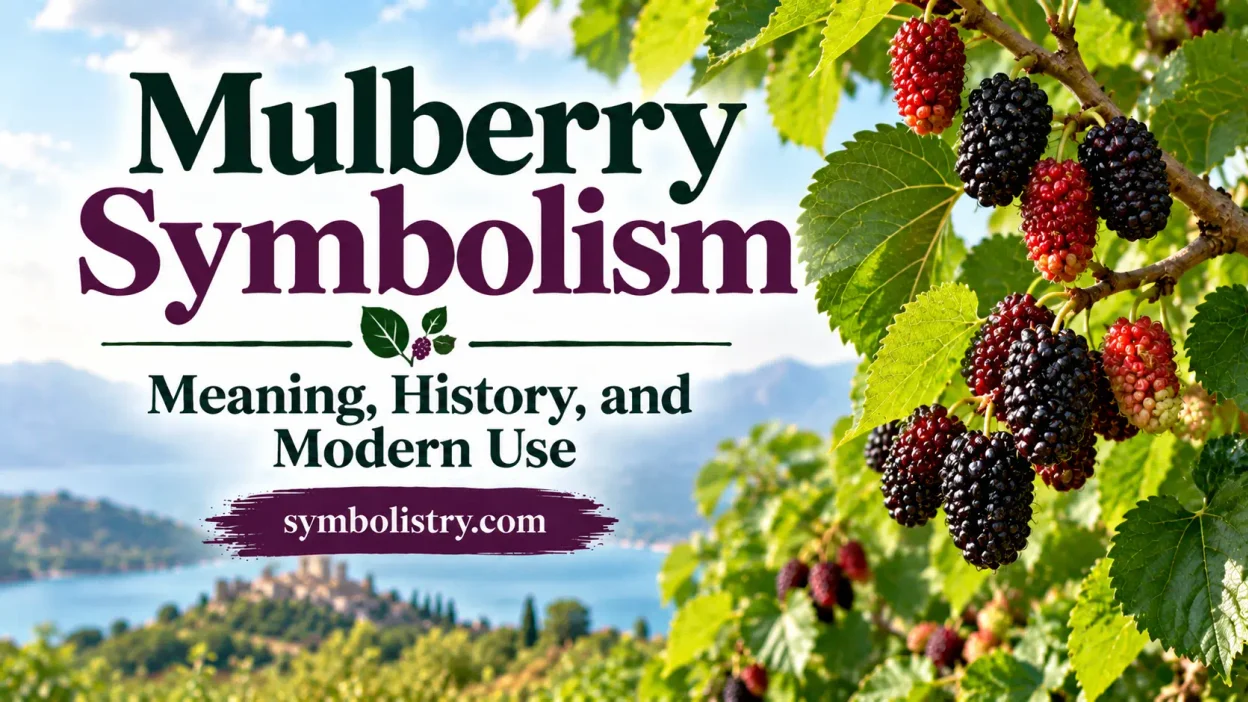
Mulberry trees carry meanings that come from practical life as much as mythology. In mulberry symbolism, the tree can represent nourishment, patience, family roots, prosperity, protection, and the transformation of ordinary natural resources into something valuable. Those associations developed because mulberries have fed people, supported silkworm cultivation, provided useful wood and fibers, and appeared in stories and religious traditions for centuries.
For Americans, the mulberry has an especially interesting history. The native red mulberry was used by Indigenous peoples for food, dyes, tools, and other practical purposes, while introduced white mulberries became closely connected with America’s early attempts to establish a domestic silk industry.
That combination gives the mulberry a different character from trees whose symbolism comes mainly from mythology. Its meanings are rooted in usefulness, cultivation, home, labor, and the relationship between people and the natural world.
Quick Answer
Mulberry symbolism commonly represents nourishment, prosperity, family roots, patience, and productive growth in modern American culture, especially when the tree or fruit appears in gardens, artwork, tattoos, and heritage imagery. Historically, mulberries also became associated with silk production, fertility, home, life, and economic ambition in Chinese, European, and American traditions.
TL;DR
- Mulberries commonly symbolize nourishment, abundance, patience, and rootedness.
- Chinese traditions connect the tree with home, life, fertility, and silk.
- Native red mulberry has a long history in North America.
- American silk experiments linked mulberries with prosperity and economic ambition.
- The tree can symbolize family heritage and connection to place.
- Modern uses include tattoos, gardens, artwork, food, and natural design.
What a Mulberry Tree Represents
A mulberry tree is recognizable by its broad leaves, spreading growth, and clusters of small fruits that can range from pale to deep red or nearly black depending on the species and stage of ripeness. Red mulberry (Morus rubra) is native to much of eastern North America, while white mulberry (Morus alba) was introduced from Asia and became important to American silk experiments.
Symbolically, the tree is often understood through what it provides.
It produces food. Its leaves feed silkworms. Its branches and wood have practical uses. It can grow for years and return with fruit season after season. These characteristics naturally support associations with nourishment, usefulness, continuity, and abundance.
Unlike a symbol that represents wealth simply because it looks luxurious, the mulberry often represents wealth through productivity: something living produces something useful.
That distinction matters when interpreting the tree in American culture.
The Mulberry as a Symbol of Nourishment
One of the oldest and most straightforward meanings of the mulberry is nourishment.
The fruit is edible, while the leaves of white mulberry are essential to traditional silkworm cultivation. In North America, Indigenous communities used native red mulberries as food and incorporated the fruit into preserved foods and other preparations. Historical accounts also describe uses of the tree’s leaves, twigs, bark, and branches.
Because of this practical relationship, a mulberry can symbolize providing for others.
A person who associates themselves with the tree might see it as an image of generosity, family care, or self-sufficiency. In a garden, a mature mulberry can similarly suggest a household that produces something useful rather than simply displaying beauty.
This is one reason the mulberry’s symbolism can feel domestic rather than grand. Its meaning begins with the simple idea of having enough to eat and having something to give.
Ancient Chinese Connections to Life and Home
The mulberry has particularly important cultural associations in China.
The Chinese mulberry, or sāng, was closely connected with sericulture, the raising of silkworms for silk. Historical scholarship on ancient Chinese literature identifies the mulberry with themes including life, love, feminine beauty, and one’s home or native place.
The connection with home is especially significant. Mulberry trees were useful plants around settled communities, and the tree became associated with the place where people lived and worked.
The relationship with silk added another layer. A humble leaf became part of the production of one of the world’s most prized textiles. The symbolic progression is easy to understand: nourishment becomes craftsmanship, craftsmanship becomes prosperity.
Chinese traditions also contain associations between mulberry imagery and fertility, agricultural life, and the continuity of human communities. These meanings should not be reduced to one universal definition, because historical Chinese symbolism varied by period, literary context, and tradition.
The Silk Connection and the Meaning of Transformation
The mulberry’s relationship with silk gives it a particularly useful symbolic theme: transformation through patient work.
Silkworms consume mulberry leaves and eventually produce silk, a material historically associated with luxury, trade, status, and skilled craftsmanship. The mulberry therefore sits at the beginning of a long chain connecting nature, labor, and finished goods.
This makes the tree a fitting symbol for people who value gradual development.
The symbolism is not that success appears instantly. Instead, something ordinary supports a process that eventually produces something valuable.
In personal symbolism, this can represent learning a skill, building a career, raising a family, or developing a creative practice. The tree’s significance comes from the process behind the result.
Why Mulberries Became Important in Early America
The mulberry acquired a distinctive American history through attempts to establish domestic silk production.
English authorities encouraged colonists in Virginia to cultivate mulberry trees and raise silkworms. By the early 1600s, colonial leaders were promoting the idea of silk as a valuable American commodity. Similar efforts appeared later in Georgia, South Carolina, Connecticut, and other regions.
The project repeatedly struggled because silk production required substantial labor and competed with more profitable agricultural activities. Nevertheless, the mulberry became associated with an ambitious idea: America could produce a valuable luxury commodity rather than depend entirely on imports.
That history added a distinctly American layer to its symbolism:
enterprise, self-reliance, productive land, and economic opportunity.
The meaning is especially interesting because the historical experiments did not ultimately produce the enormous silk industry their promoters envisioned. The mulberry therefore also carries a lesson about ambition, speculation, and the gap between agricultural promise and economic reality.
Mulberry Symbolism in the United States
In the United States, there is no single official or universally recognized meaning for the mulberry tree. Its symbolism is more personal and regional than that of familiar national symbols such as the oak or rose.
Still, several associations stand out.
| Context | Meaning in the USA | Common Associations | Notes |
|---|---|---|---|
| Garden or landscape | Nourishment and productivity | Food, shade, cultivation | Emphasizes practical value |
| Family heritage | Roots and continuity | Home, ancestry, place | Often works well in family imagery |
| Silk history | Enterprise and ambition | Industry, craftsmanship, prosperity | Connected to early American experiments |
| Fruit imagery | Abundance and generosity | Harvest, food, sharing | More seasonal and domestic |
| Tattoo or artwork | Growth and resilience | Nature, patience, identity | Meaning depends heavily on personal context |
The native red mulberry is particularly relevant to American history because it existed here long before European settlement. Historical accounts describe Indigenous uses of the fruit and other parts of the tree, giving the American mulberry story a deeper history than the later silk experiments alone suggest.
Native American and Indigenous Contexts
It is important not to describe Indigenous cultures as if they shared one symbolic system. Different nations had their own languages, traditions, ecological knowledge, and uses for native plants.
What can be documented is the practical importance of red mulberry among several Indigenous communities. Historical accounts describe the fruit being eaten fresh or preserved, while parts of the plant were used for dyes, tools, bows, and other purposes.
These uses support an interpretation of the native mulberry as a plant of resourcefulness and provision.
That symbolism is different from the later American association with silk speculation. One emphasizes an established relationship with a native food plant; the other reflects an economic project built around an introduced species.
Keeping those histories separate makes the symbolism more accurate.
The Mulberry in Greek and Roman Tradition
European traditions added another set of stories to the mulberry.
One of the best-known classical associations comes from the story of Pyramus and Thisbe, two lovers whose deaths are said to have changed the color of the mulberry’s fruit from white to dark red. The story became part of the literary tradition that later influenced Shakespeare’s Romeo and Juliet.
Here the mulberry becomes associated with love, tragedy, blood, and irreversible change.
The story illustrates why color can alter the symbolism of a natural object. A pale mulberry may evoke innocence or beginnings, while a dark red or black fruit can evoke passion, loss, or the consequences of intense emotion.
The classical story should not be treated as the universal meaning of the tree. It is one cultural narrative among many, but it has had an enduring influence on Western literary associations.
The Mulberry in Biblical Symbolism
The mulberry tree also appears in the New Testament.
In Luke 17:6, Jesus refers to faith being able to command a mulberry tree to be uprooted and planted in the sea. The passage uses the tree as an example of something deeply rooted that could nevertheless be moved through faith.
Because of this passage, Christian readers may encounter the mulberry in discussions about faith, rootedness, and extraordinary change.
The emphasis is not that mulberries universally symbolize Christianity. Rather, the tree has a specific place within a biblical teaching, and that passage has influenced how the tree can be interpreted in religious artwork or devotional writing.
This distinction is useful because symbolic meaning often depends on context. A mulberry in a biblical illustration does not necessarily carry the same message as one in a Chinese silk painting or an American garden.
What Mulberry Fruit Can Symbolize
The fruit introduces another layer of meaning.
Mulberries develop from small flowers into clusters of juicy berries that darken as they mature. That progression makes them natural symbols of ripening, maturity, harvest, and abundance.
Their staining quality can also affect their visual symbolism. Dark mulberry juice leaves a noticeable mark, which can make the fruit suggest intensity, memory, or something difficult to erase in artistic contexts.
Color changes the interpretation:
- White mulberries may suggest simplicity, cultivation, silk, and new beginnings.
- Red mulberries can suggest vitality, love, and the native American landscape.
- Dark purple or black fruit can suggest maturity, richness, remembrance, or mortality.
These are interpretive associations rather than fixed rules. The same fruit can mean something entirely different depending on the surrounding imagery.
Emotional and Psychological Meaning
The mulberry is particularly well suited to symbolism involving belonging and continuity.
A tree grows in one location while changing from season to season. That combination makes it a useful metaphor for identity: a person can change considerably without losing every connection to where they began.
For someone thinking about family, the mulberry may therefore represent ancestry or a home that continues to influence later generations.
Its fruit also makes the symbolism more grounded than abstract. The tree does not simply “represent life” in an empty sense. It produces something that can be gathered, eaten, shared, preserved, or transformed into another product.
Emotionally, this can make the mulberry a symbol of care that becomes tangible.
Why the Mulberry Appears in Personal Symbolism
People may choose mulberry imagery because it connects several ideas at once: family, food, nature, craftsmanship, heritage, and growth.
For a tattoo, the tree can represent one’s roots or a connection to a particular place. A cluster of berries can represent abundance or an important stage of life. A silkworm and mulberry leaf can emphasize transformation and patient work.
The symbolism becomes more personal when combined with other elements.
For example, a mulberry branch with family initials may emphasize ancestry. A flowering or fruiting branch may emphasize growth. A dark fruit against pale leaves might intentionally draw on the Pyramus and Thisbe story.
The surrounding design usually matters as much as the tree itself.
Mulberry Symbolism in Home Decor and Gardens
In contemporary American design, botanical imagery is often used to create a sense of natural heritage.
Mulberry branches can work particularly well in kitchens, dining areas, gardens, textiles, prints, and rustic or traditional interiors because the plant has a strong connection with food and cultivation.
A mulberry image can suggest hospitality and provision without using a conventional food symbol.
In landscaping, an actual mulberry tree can carry a different kind of meaning. It may represent a connection to an older garden tradition or an appreciation for plants that provide food for both humans and wildlife.
The practical qualities of the tree are therefore part of its aesthetic appeal.
Mulberry Trees and American Economic Ambition
Perhaps the most unusual part of American mulberry history is the nineteenth-century “mulberry mania.”
During the 1830s, enthusiasm for silk production led to widespread planting and speculation in mulberry trees, particularly in Connecticut. The trees became associated with the hope of economic prosperity and productive enterprise before the boom collapsed.
This episode adds a cautionary dimension to the tree’s symbolism.
Mulberries can represent ambition and opportunity, but their history also demonstrates that optimism about a profitable natural resource can become excessive speculation.
That makes the mulberry an unusually appropriate symbol for the American relationship with entrepreneurship: opportunity may be real, but expectations can outrun practical conditions.
Common Misunderstandings About Mulberry Symbolism
The biggest misunderstanding is assuming that the mulberry has one universal symbolic meaning.
It does not.
Meanings vary according to culture, species, historical period, religious setting, color, and personal use. A mulberry connected with Chinese sericulture has a different historical background from a native red mulberry used as food in North America.
Another common mistake is treating every mulberry-related story as equally old or historically established. Some meanings come from documented traditions, while others are later literary, decorative, or modern interpretations.
The safest approach is to identify which tradition and context are being discussed rather than assigning a single definition to the entire plant.
How Mulberry Symbolism Has Changed Over Time
The history of the mulberry shows a gradual expansion of meaning.
In early agricultural societies, its value was closely tied to food, cultivation, and human survival. In China, its connection to sericulture gave it economic, domestic, and cultural importance. Classical European literature added stories about love and tragedy. Biblical writing gave the tree a specific religious role. American history later connected it with silk production, economic independence, entrepreneurship, and speculation.
Today, people are more likely to encounter the mulberry as a fruit tree, garden plant, botanical illustration, historical reference, or personal design.
Its symbolism has therefore moved from necessity toward identity.
The tree once mattered because people needed what it produced. Today, people can also use it to express where they come from, what they value, or how they understand growth and continuity.
FAQ: What does a mulberry tree symbolize?
A mulberry tree can symbolize nourishment, abundance, family roots, patience, productivity, and continuity. Its historical associations with silk production also connect it with craftsmanship and economic ambition.
Is the mulberry tree a symbol of family?
It can be. In Chinese cultural traditions, mulberry imagery has been associated with one’s home or native place, while its long-lived, productive nature makes it suitable for modern interpretations involving ancestry and family continuity.
What does a mulberry symbolize in the Bible?
The mulberry appears in Luke 17:6 in a teaching about faith and the ability to command a deeply rooted tree to be uprooted and planted in the sea. In Christian interpretation, it can therefore be associated with faith and dramatic change.
What does a mulberry tattoo mean?
A mulberry tattoo can represent roots, family, abundance, patience, personal growth, or a connection to nature. Its meaning can become more specific through added elements such as fruit, leaves, silkworms, names, dates, or religious imagery.
What does the mulberry symbolize in Chinese culture?
The mulberry has major historical associations with sericulture, agriculture, home, life, and community. Traditional Chinese literary scholarship also identifies mulberry imagery with themes such as love, feminine beauty, and one’s native place.
Does a black mulberry symbolize death?
Not necessarily. Dark mulberry fruit can evoke maturity, passion, remembrance, or mortality in particular artistic contexts, but there is no universal rule that black mulberries symbolize death.
Why are mulberries associated with prosperity?
Their association with prosperity partly comes from their role in silk production. Because silkworms depend on mulberry leaves, cultivating the trees could support a valuable textile industry; in the United States, nineteenth-century silk enthusiasts explicitly connected mulberry cultivation with economic opportunity.
Conclusion
The mulberry is a symbol shaped by usefulness. Its meanings come from food, cultivation, silk, family, home, literature, religion, and the long process by which natural resources become part of human culture.
In the United States, mulberry symbolism can express nourishment, rootedness, productivity, heritage, and the hope that patient work will eventually produce something valuable. Its history also adds a more complicated lesson: the same tree that represented economic opportunity during America’s silk experiments became part of a story about speculation and changing expectations.
That combination makes the mulberry especially suited to modern symbolism. It can represent where a person comes from while also suggesting what they are still growing toward.


[…] a memory or impression before they even identify the plant. That makes it an especially fitting symbol for meanings that are felt through experience rather than announced by […]