Harpy symbolism centers on sudden disruption, predatory force, punishment, and the unsettling boundary between human and animal. In ancient Greek mythology, harpies were winged female figures associated with storm winds and sudden acts of taking or carrying away; later traditions increasingly portrayed them as frightening, filthy creatures.
Today, Americans are more likely to encounter harpies through fantasy art, novels, video games, tattoos, Halloween imagery, and adaptations of classical mythology than through formal religious practice. Their unusual appearance—a human woman combined with wings, claws, or birdlike features—makes them useful as symbols of independence, danger, rage, predation, and the refusal to fit neatly into ordinary categories.
Understanding the symbol requires separating the ancient harpy from the modern fantasy creature. The original myths were more varied than the familiar monster image suggests, and their meaning changed substantially between Greek, Roman, medieval, and modern interpretations.
Quick Answer
Harpy symbolism commonly represents danger, sudden disruption, punishment, and untamed forces in modern American culture, especially in fantasy art, tattoos, and stories about fierce or threatening female figures. Historically, harpies were associated with storm winds, sudden disappearance, divine punishment, and the act of snatching people or possessions away.
TL;DR
- Harpies originally represented sudden storm winds and forces that snatch things away.
- Greek myths connected them with disappearance, punishment, and divine authority.
- Roman literature developed their frightening, filthy monster-like appearance.
- Modern Americans often associate harpies with danger, independence, and fierce femininity.
- Fantasy media frequently reimagines harpies as intelligent winged humanoids.
- Their symbolism depends heavily on whether the context is ancient or modern.
What Does a Harpy Look Like?
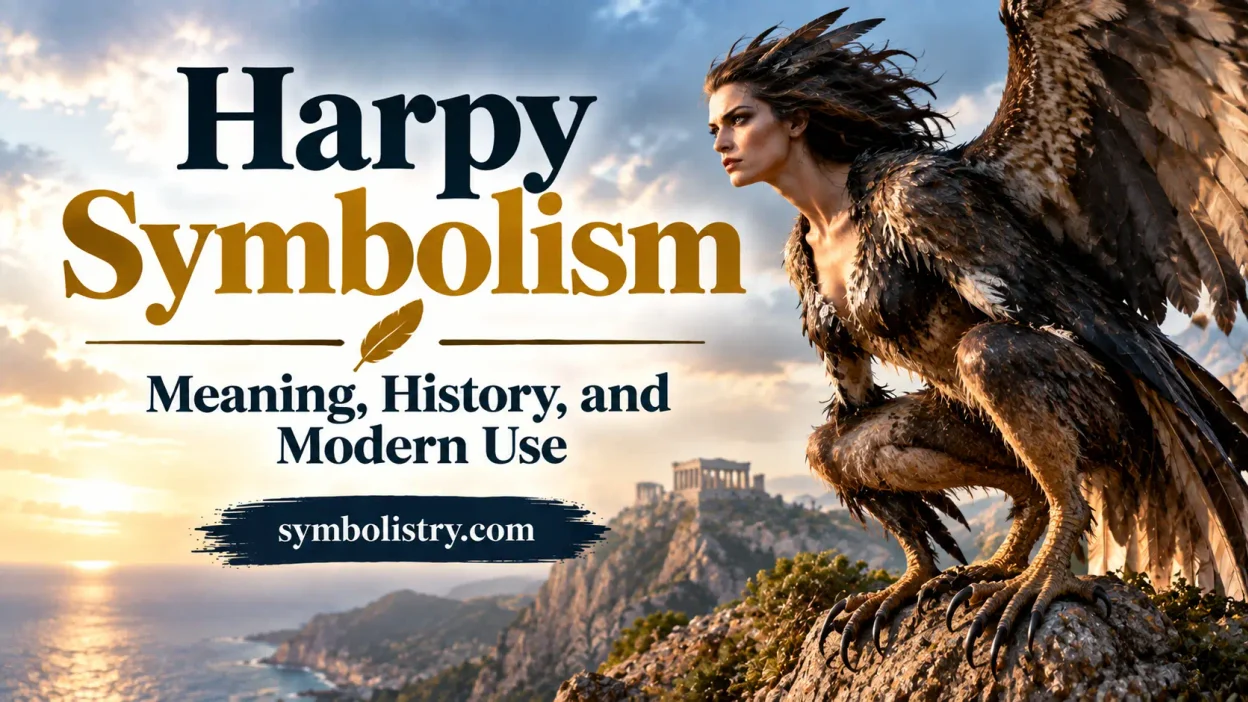
The traditional harpy is a hybrid creature combining human and avian characteristics. Modern illustrations commonly show a woman with large wings, sharp talons, feathers, and sometimes a birdlike lower body.
Ancient Greek representations were not completely consistent. Early literary descriptions could portray harpies as winged maidens, while later writers and artists emphasized ugliness, claws, birdlike bodies, hunger, and filth. This change matters because the familiar monstrous harpy is not the only form found in classical tradition.
Harpies are also frequently confused with sirens. The two creatures became visually closer in later art, but they originally had different mythological identities. Greek artistic traditions generally distinguished the harpy as a winged woman from the siren’s more bird-bodied form.
That distinction is useful when interpreting ancient artwork. A woman-bird figure is not automatically a harpy.
The Original Meaning: Storm, Wind, and Sudden Taking
One of the oldest layers of harpy symbolism is connected with the wind.
In early Greek tradition, harpies were associated with swift storm winds and sudden movement through the air. Their name is traditionally connected with the idea of snatching or carrying away, which fits their mythological function. Homer associates them with people who suddenly disappear, while Hesiod describes winged female beings capable of moving faster than winds and birds.
This gives the harpy a distinctive symbolic meaning: something arrives suddenly, takes what it wants, and disappears before it can be controlled.
The idea can represent more than physical violence. A storm, unexpected loss, abrupt separation, or uncontrollable event can all be expressed through the same imagery.
The harpy therefore began less as a generic female monster and more as a personification of forces that could not easily be restrained.
Harpies and the Story of Phineus
The best-known Greek story involving harpies concerns Phineus, a king of Thrace who was tormented by the creatures.
Whenever food was placed before him, the harpies swooped down and took it away, leaving behind spoiled or contaminated remains. The Argonauts eventually encountered Phineus and helped drive the harpies away.
This story established several symbolic associations that remain recognizable today:
- deprivation
- interference
- hunger
- punishment
- contamination
- relentless harassment
- the inability to enjoy something without interruption
The harpies are especially interesting because their threat is not simply physical attack. They deny access to something necessary.
Food normally represents nourishment, hospitality, security, and ordinary life. By stealing it, the harpies transform an everyday act into an experience of anxiety and deprivation.
That makes them particularly effective symbols for forces that repeatedly disrupt stability.
How Greek and Roman Traditions Changed the Harpy
The harpy did not retain one fixed appearance throughout classical literature.
Hesiod’s harpies could be beautiful, winged maidens with exceptional speed. Later descriptions became increasingly grotesque. By the Roman period, writers such as Virgil and Ovid presented them as foul creatures with female faces, wings, claws, hunger, and an association with pollution or punishment.
Virgil’s Aeneid is especially important for the later image. When Aeneas and his companions encounter the harpies, the creatures descend upon their food, defile it, and issue a threatening prophecy through Celaeno.
The evolution is significant. The early harpy could symbolize swift natural force, while later versions increasingly represented horror, punishment, hunger, and contamination.
Modern images often combine both traditions: the elegant winged woman from early mythology and the monstrous predator developed by later writers.
What Harpies Symbolize in the United States
There is no single official American meaning for the harpy. Unlike symbols such as the bald eagle, flag, or wedding ring, the harpy has no established national symbolism.
Instead, Americans generally encounter the figure through mythology, fantasy entertainment, visual art, literature, gaming, and popular culture.
In those settings, the harpy often communicates:
- danger
- fierce independence
- aggression
- predatory instincts
- freedom from ordinary human limitations
- female anger
- transformation
- otherness
- chaotic or uncontrollable behavior
The interpretation depends heavily on the portrayal.
A beautiful winged woman may suggest freedom, independence, or supernatural identity. A clawed creature attacking a character may represent violence or predation. A tragic harpy character may instead symbolize alienation or being treated as a monster because of her appearance.
This flexibility is one reason the creature remains useful in contemporary storytelling.
Harpy Symbolism and Feminine Power
Modern interpretations frequently connect harpies with femininity, but this requires some caution.
The ancient stories do not provide a straightforward model of female empowerment. Harpies were female-coded supernatural beings, yet many classical authors portrayed them negatively. Their bodies combined human femininity with animal characteristics, making them figures of attraction, discomfort, danger, and boundary crossing.
Modern creators can reinterpret that imagery.
A harpy may represent a woman who refuses to behave according to expectations of gentleness or obedience. In fantasy, the creature can become a visual expression of anger, independence, physical strength, or refusal to be controlled.
This is a modern reinterpretation, not a simple continuation of ancient Greek meaning.
That distinction matters. Calling every harpy image an ancient symbol of female empowerment would flatten a much more complicated history.
The Harpy as a Symbol of Uncontrolled Anger
Anger is one of the most recognizable modern interpretations of the harpy.
The creature’s claws, wings, sharp facial expressions, and aggressive movements make it visually suited to representing rage. Unlike a calm bird soaring through the sky, the harpy is usually depicted in motion—diving, attacking, grabbing, or screaming.
This creates a particular emotional association: anger that has become difficult to contain.
For some modern artists, that can be negative. The harpy may represent destructive rage, hostility, or cruelty.
For others, it can be a metaphor for anger that has been suppressed for too long. In that interpretation, the wings and claws become visual tools for reclaiming strength rather than signs of evil.
The surrounding story determines which reading makes sense.
Harpies, Fear, and the Psychology of the Monster
Harpies are psychologically interesting because they combine familiar and unfamiliar features.
The human face encourages recognition. The wings, feathers, talons, and predatory behavior create distance. The result is neither fully human nor fully animal.
Hybrid creatures often work this way in mythology. They make abstract fears visible by giving them bodies.
A harpy can therefore symbolize the fear of encountering something that looks partly familiar but behaves according to completely different rules.
That may explain why the figure works so well in horror and fantasy. It turns uncertainty into a recognizable character.
The symbolism can also apply to social identity. Someone who feels caught between categories—human and animal, civilized and wild, accepted and rejected—can use a hybrid creature as a metaphor for living outside conventional boundaries.
Harpy Symbolism in Death and Disappearance
Harpies also have connections with disappearance and death, although they should not simply be classified as Greek goddesses of death.
Early traditions connect them with people who suddenly vanished, while later stories place them among creatures associated with punishment and the underworld.
Their ability to swoop down and carry something away gives them an obvious connection with loss.
There is also important archaeological complexity. The so-called Harpy Tomb in Lycia contains bird-woman figures once identified as harpies, but modern scholarship commonly identifies them as sirens, while other scholars have argued that the older harpy interpretation may still deserve consideration.
This is a good example of why ancient symbolism should not be reduced to simple dictionary definitions. Identification itself can be debated.
Harpies Compared With Sirens
The confusion between harpies and sirens is especially common in modern popular culture.
| Context | Harpy Meaning | Siren Meaning | Key Difference |
|---|---|---|---|
| Ancient Greek tradition | Wind, sudden taking, punishment | Seduction, dangerous song | Different mythic functions |
| Classical art | Often winged female figure | Bird-bodied woman | Visual forms could overlap later |
| Roman literature | Filth, hunger, threat | Enchantment and fatal attraction | Different narrative roles |
| Modern fantasy | Fierce winged creature | Seductive or aquatic supernatural being | Popular culture often simplifies both |
| Modern symbolism | Anger, danger, wildness | Temptation, allure, obsession | Emotional associations differ |
Sirens are primarily associated with song, seduction, and the danger of irresistible attraction. Harpies are more strongly associated with snatching, disruption, punishment, and predatory force.
The distinction is particularly important when interpreting ancient artwork.
Harpy Symbolism in Tattoos
A harpy tattoo can carry several meanings, depending on its design.
A person may choose one to represent independence, anger, resilience, transformation, wildness, or an attraction to classical mythology. A detailed classical-style harpy may emphasize historical mythology, while a modern fantasy design can communicate strength or rebellion.
The expression and posture change the message.
A harpy with spread wings can suggest freedom or escape. A diving harpy may communicate aggression. A seated or restrained figure can suggest captivity or alienation. A design surrounded by storm clouds may emphasize the creature’s older relationship with wind and sudden danger.
Because harpy imagery is uncommon compared with dragons, phoenixes, or butterflies, the tattoo may also function as a signal of specialized interest in mythology or fantasy.
Harpies in Fantasy, Games, and Popular Culture
Modern fantasy has transformed the harpy into a much broader character type.
Instead of appearing only as a monster, harpies may be portrayed as intelligent societies, warriors, antagonists, comic characters, magical beings, or misunderstood outsiders. This approach separates modern fantasy from the moral framework of many ancient stories.
The change reflects a broader trend in mythology-based entertainment: creatures once presented as monsters are increasingly given personalities and perspectives.
As a result, a harpy can now symbolize difference rather than simple evil.
A fictional harpy character may be frightening to humans within a story while simultaneously being sympathetic to the audience. The creature’s physical difference becomes part of the narrative rather than proof of moral corruption.
Harpies in Art, Fashion, and Decorative Design
Harpies are less common in mainstream American home décor than angels, birds, flowers, skulls, or classical busts, but they appear in niche Gothic, fantasy, and mythology-inspired design.
Artists may use wings and talons as dramatic visual elements without intending to reproduce the ancient mythology accurately.
Fashion can similarly borrow the harpy’s visual language—feathers, sharp silhouettes, dark wings, metallic claws, and birdlike details—to suggest rebellion or theatricality.
In these contexts, the harpy functions less like a fixed religious symbol and more like a visual vocabulary for wildness and danger.
Common Misunderstandings About the Harpy
One common misconception is that harpies were always half-bird women with ugly faces and claws. Early Greek descriptions were more varied, and some traditions presented them as beautiful winged maidens. Their later monstrous appearance became especially influential through authors such as Virgil and Ovid.
Another misconception is that harpies and sirens are the same creature. They were distinct figures in Greek mythology, although later artistic traditions sometimes brought their appearances closer together.
It is also misleading to describe harpies simply as “evil.” Their mythological roles involve punishment, sudden disappearance, storms, deprivation, and divine authority. Their behavior can be frightening, but their symbolism is broader than a modern good-versus-evil category.
How Harpy Meaning Has Evolved
The history of the harpy shows how symbolism changes when a figure moves between cultures and genres.
In early Greek tradition, the harpy was closely associated with wind and sudden movement. Later literature emphasized frightening physical characteristics and punishment. Roman poetry strengthened the image of the filthy, hungry monster. Medieval and Renaissance readers encountered the figure through classical literature, while modern fantasy turned the harpy into a flexible supernatural character.
Today, the creature can represent almost opposite ideas depending on context: destruction or independence, predation or freedom, rage or resilience, monster or misunderstood outsider.
That flexibility is not a contradiction. It is the result of centuries of reinterpretation.
A Practical Way to Interpret Harpy Imagery
When you encounter a harpy in art, literature, a tattoo, or a fictional story, look at the surrounding details before assigning a meaning.
Ask four questions:
- What is the harpy doing? Attacking, flying, guarding, fleeing, or simply observing?
- How is it portrayed? Beautiful, monstrous, tragic, comic, or heroic?
- What surrounds it? Storms, graves, weapons, flowers, other animals, or human figures?
- What cultural tradition is being referenced? Ancient Greek mythology, Roman literature, Gothic art, fantasy, or modern popular culture?
A harpy carrying someone away has a very different message from a harpy spreading its wings above a landscape.
The image’s context often tells you more than the creature’s name alone.
Frequently Asked Questions
What does a harpy symbolize?
A harpy can symbolize sudden disruption, danger, punishment, predatory force, and uncontrollable natural power. In modern American culture, the figure may also represent independence, anger, rebellion, or a refusal to conform.
What does a harpy tattoo mean?
A harpy tattoo can represent fierce independence, strength, anger, wildness, transformation, or an interest in mythology. The pose and surrounding imagery usually determine the specific interpretation.
Are harpies evil in Greek mythology?
Greek mythology does not reduce harpies to a simple concept of evil. They function as supernatural forces associated with storms, sudden taking, punishment, deprivation, and divine authority.
Are harpies and sirens the same?
No. Ancient Greek traditions treated them as different mythological beings, although their appearances became confused in some later artwork and literature. Sirens were especially associated with dangerous song, while harpies were associated with taking, storms, and punishment.
Do harpies symbolize women?
They can symbolize feminine power in modern interpretations, particularly when artists use the creature to represent independence, anger, or resistance to control. That interpretation is largely modern and should not be presented as the single meaning of the ancient myth.
What do harpies symbolize in dreams?
A harpy in a dream may be interpreted personally as a representation of conflict, fear, anger, sudden loss, or feeling threatened by an uncontrollable situation. Dream symbolism is highly individual, so the circumstances and emotions surrounding the image matter more than a fixed mythological definition.
Why are harpies associated with hunger?
In the story of Phineus, harpies repeatedly stole or spoiled his food, leaving him unable to eat normally. Later literature reinforced their association with hunger, contamination, and deprivation.
Conclusion
The history of harpy symbolism is a story of transformation. What began in Greek tradition as a figure connected with swift winds, sudden disappearance, and the act of snatching gradually became a more grotesque creature associated with hunger, punishment, contamination, and fear. Roman literature played an important role in establishing the monster-like image that remains familiar today.
In modern American culture, harpies have moved beyond their original mythological roles. They can represent danger, fierce independence, anger, wildness, alienation, or resistance to control, particularly in tattoos, fantasy art, games, and popular storytelling.
The most useful interpretation depends on context. A harpy is not simply a monster or a symbol of evil; it is a flexible mythological figure whose meaning has changed as artists, writers, and audiences have given the creature new roles.