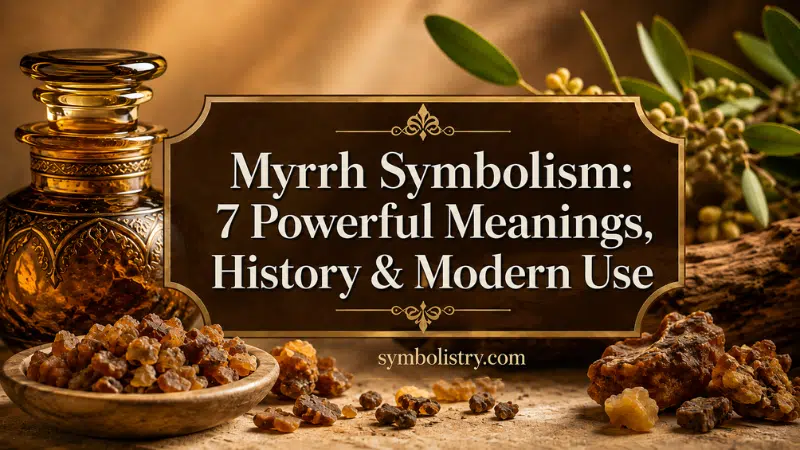
Myrrh is a fragrant resin that has been valued for thousands of years, and myrrh symbolism developed from its roles in medicine, perfume, burial, worship, and trade. The reddish-brown resin comes from trees and shrubs in the Commiphora genus, particularly species native to parts of northeastern Africa and the Arabian Peninsula.
Unlike symbols that exist mainly as images or signs, myrrh carries meaning through its physical qualities. It has a distinctive scent, comes from a tree’s wounded bark, and was historically difficult to obtain and transport over long distances. Those characteristics helped make it useful in rituals and gave it associations with sacrifice, preservation, mourning, devotion, healing, and preciousness.
For modern Americans, myrrh is probably most recognizable from the biblical story of the Magi bringing gifts to Jesus. Yet its history is much broader than Christianity. Ancient Egyptians, Greeks, Romans, Jewish communities, and societies in Africa and Arabia all used myrrh in different ways.
Understanding those different uses helps explain why the resin can symbolize both life and death, celebration and mourning, earthly luxury and religious devotion.
Quick Answer
Myrrh symbolism commonly represents sacrifice, devotion, healing, mourning, and spiritual significance in modern American culture, especially in Christian contexts. Historically, myrrh was also associated with perfume, medicine, burial, purification, luxury, and long-distance trade across Africa, Arabia, and the Mediterranean.
TL;DR
- Myrrh is a fragrant resin produced by trees of the Commiphora genus.
- Christian tradition connects myrrh with Jesus, sacrifice, and mortality.
- Ancient societies used myrrh for perfume, medicine, worship, and burial.
- Its fragrance helped associate myrrh with purification and sacred spaces.
- Modern Americans often recognize myrrh through Christmas and biblical traditions.
- Contemporary uses include incense, fragrance, personal care, and religious practice.
What Is Myrrh and Where Does It Come From?
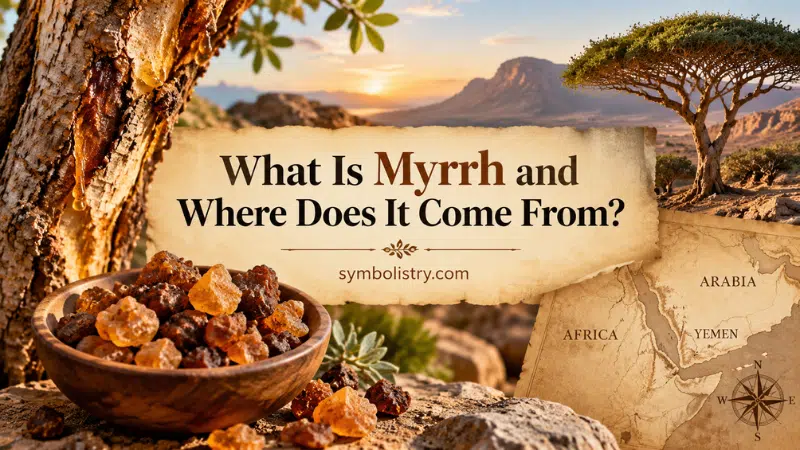
Myrrh is an aromatic gum-resin obtained from certain Commiphora trees and shrubs. When the bark is cut or naturally damaged, resin can emerge and harden into irregular pieces that range from yellowish to reddish-brown.
The material’s physical character is central to understanding its historical importance.
Fresh resin does not simply look like an ordinary perfume ingredient. It is a hardened substance produced by a tree, and it releases a distinctive fragrance when burned or processed.
Historically, myrrh was collected in regions that include parts of modern Yemen, Oman, Somalia, Ethiopia, Eritrea, and neighboring areas. Different species and regional products were used, so ancient references to myrrh do not necessarily describe exactly the same material.
Its value was also connected to geography.
Myrrh-producing regions were linked to major ancient trade networks. Merchants moved aromatic resins toward Egypt, the Levant, Mesopotamia, Greece, Rome, and other markets.
That movement turned myrrh into more than a natural substance. It became a traded luxury associated with wealth, foreign lands, ritual activity, and specialized knowledge.
Why Fragrance Became Part of Myrrh’s Symbolism
Smell played a much larger role in ancient ritual life than many modern readers realize.
Before modern sanitation, refrigeration, and manufactured fragrances, naturally aromatic materials had practical value as well as sensory appeal. Myrrh could be burned as incense, incorporated into perfumes, and used in preparations intended for the body.
Its strong scent made it particularly suitable for sacred settings.
When an aromatic resin is burned, its fragrance spreads through an entire room. That physical transformation helped make incense an effective ritual material. A person could see smoke, smell the fragrance, and associate the experience with worship.
Myrrh therefore acquired associations with purification, reverence, sacred space, and offering.
The symbolic connection was not simply that myrrh smelled pleasant. Its scarcity, cost, preparation, and ritual use all helped distinguish it from ordinary household materials.
A substance reserved for important ceremonies naturally acquired greater cultural significance.
This is one reason myrrh appears alongside other valuable aromatics in ancient religious and ceremonial traditions.
Myrrh Symbolism in Ancient Egypt
Myrrh had an important place in ancient Egyptian life.
Egyptians used aromatic resins in religious practices, cosmetics, medicine, and funerary customs. Fragrant substances were especially relevant to the treatment and commemoration of the dead.
Egyptian funerary culture placed considerable emphasis on preserving the body and preparing it for the afterlife. Aromatic materials were part of a much larger system of embalming and ritual care.
Myrrh’s association with the dead therefore contributed to one of its most enduring symbolic tensions: fragrance could represent both life and death.
A pleasant scent could be associated with cleanliness, beauty, and divine worship, while the same aromatic material could be used in connection with burial.
This dual role matters when interpreting later traditions.
Myrrh should not be reduced to a simple “death symbol.” Its funerary associations developed alongside uses connected with health, beauty, worship, and luxury.
Egyptian use also demonstrates that the symbolism surrounding myrrh predates Christianity by many centuries.
Myrrh in Ancient Jewish and Biblical Traditions
Myrrh appears repeatedly in the Hebrew Bible and related Jewish traditions.
It is associated with fragrance, anointing, sacred preparations, beauty, and valuable perfume. References to myrrh can occur in descriptions of worship as well as poetic passages involving love and attraction.
The material’s presence in these different contexts shows that myrrh did not have one fixed meaning.
It could be connected with sacred practice, personal fragrance, celebration, and luxury.
The biblical Song of Songs, for example, uses myrrh as part of its rich language of fragrance and beauty. Elsewhere, myrrh appears among valuable aromatic substances.
This broader biblical background becomes important when considering Christianity.
Christian interpretations did not emerge from nowhere. They developed within an older Jewish and Mediterranean world where myrrh already carried associations with costly fragrance, ritual use, the body, and burial.
That history gives later Christian symbolism additional layers.
The Three Gifts of the Magi and Christian Symbolism
For many Americans, the most familiar association with myrrh comes from the Christmas story.
In the Gospel of Matthew, the Magi present Jesus with gold, frankincense, and myrrh. The biblical account names the gifts but does not provide an explanation of what each gift symbolized.
Later Christian interpretation developed symbolic readings of the three substances.
Gold became associated with kingship. Frankincense was connected with divinity and worship. Myrrh came to represent suffering, mortality, and burial, particularly in relation to the later Passion of Christ.
This interpretation is important, but it should be described as later Christian symbolism, not as an explicit explanation supplied by the Gospel itself.
The connection became especially meaningful because myrrh appears again in the New Testament in contexts surrounding Jesus’ death and burial.
This creates a literary and theological connection between the beginning and end of Jesus’ earthly life.
For Christians, myrrh can therefore symbolize the human vulnerability of Christ, sacrifice, death, and the belief that death does not have the final word.
That is one reason myrrh remains particularly prominent during Christmas and Holy Week.
Myrrh as a Symbol of Sacrifice
Sacrifice is one of the strongest symbolic meanings attached to myrrh in Christian interpretation.
Part of this association comes from its connection with Christ’s suffering and burial. Part comes from the historical character of myrrh itself: it was valuable, aromatic, and deliberately offered for important purposes.
In religious symbolism, an expensive substance used in worship can communicate devotion.
The person giving it is not merely giving something convenient. The value of the material becomes part of the offering.
This idea can extend beyond Christianity.
Across many cultures, valuable fragrances and aromatic materials have been offered in religious ceremonies because they transform ordinary space into a setting marked for ritual use.
Myrrh’s symbolic relationship with sacrifice therefore has both a specific Christian history and a broader history of ceremonial offering.
The meaning is strongest when the material is understood as something intentionally given rather than merely consumed.
Myrrh and the Symbolism of Mourning and Death
Myrrh’s association with mourning is closely tied to its ancient funerary uses and Christian traditions surrounding burial.
In the ancient Mediterranean world, aromatic substances were used in connection with the dead for practical, ceremonial, and sensory reasons.
Fragrance could help create an environment associated with dignity and ritual care.
Christian tradition later connected myrrh with the burial of Jesus. The Gospel of John describes Nicodemus bringing myrrh and aloes in connection with Jesus’ burial.
This helped strengthen the association between myrrh and death.
Yet the symbolism is more nuanced than simply “myrrh means death.”
It can represent honoring the dead, caring for the body, accepting mortality, and remembering a person with dignity.
That distinction matters.
In a memorial or religious setting, myrrh may evoke mourning without implying despair. Its traditional use can acknowledge death while also pointing toward religious ideas about resurrection and eternal life.
Myrrh as a Symbol of Healing
Myrrh has also been associated with healing and bodily care for thousands of years.
Ancient medical traditions used myrrh in various preparations, and the resin became part of historical herbal and medicinal practices.
Modern scientific research has investigated compounds found in myrrh and related Commiphora species, but historical medicinal use should not automatically be treated as proof that every traditional claim is medically effective.
Symbolically, however, the association with healing is straightforward.
A substance used on the body for care can become connected with restoration, protection, and recovery.
This gives myrrh a meaning that balances its funerary associations.
The same resin that became connected with burial could also be associated with caring for the living.
That contrast is part of what makes myrrh culturally interesting. It occupies the space between physical vulnerability and attempts to care for the body.
Myrrh, Purification, and Sacred Space
Burning aromatic substances has long been a way of marking sacred or ceremonial space.
Myrrh’s fragrance can change the atmosphere of a room quickly, making it useful for ritual contexts.
When people encounter incense during worship, the smell itself can become part of memory. A fragrance experienced repeatedly during prayer or ceremony may later evoke that religious setting even outside the original location.
This gives myrrh a psychological dimension.
Its symbolism can operate through memory and association, not just through formal religious teachings.
For someone raised in a Christian tradition, the smell of incense may immediately recall church services, Christmas celebrations, funerals, or other religious experiences.
For another person, myrrh may simply suggest ancient ritual, natural fragrance, or traditional herbal practice.
The meaning depends partly on personal experience.
What Myrrh Symbolizes in Modern American Culture
In the United States, myrrh is most recognizable through Christianity, Christmas traditions, religious education, and biblical storytelling.
Many Americans first encounter the word through the phrase “gold, frankincense, and myrrh.”
That association makes myrrh especially visible during the Christmas season.
Churches, nativity displays, children’s programs, religious artwork, and Christmas lessons may mention the three gifts of the Magi. For Christian audiences, myrrh can therefore function as a compact reference to the story of Jesus’ birth and the later significance of his death.
Outside explicitly religious settings, myrrh is less universally recognized.
Some Americans encounter it through incense, fragrance products, herbal traditions, essential-oil culture, or historical discussions of ancient trade.
Its modern American meaning is consequently divided between religious symbolism and botanical or fragrance culture.
The Christian association remains the most culturally recognizable, but it is not the only one.
Myrrh Symbolism Across Cultures and Religions
Myrrh was traded across a wide geographical area, so its history cannot be assigned to a single culture.
Ancient Egyptian, Jewish, Greek, Roman, Arabian, African, and later Christian traditions all contributed to the cultural history surrounding aromatic resins.
Their uses were not identical.
In one setting, myrrh could be associated with temple ritual. In another, it could function as perfume or medicine. In another, it could be used in connection with burial.
This variation is important because it prevents a simplistic interpretation.
There is no single ancient “myrrh meaning” that every culture shared.
Instead, several recurring themes developed around the material’s characteristics and uses: fragrance, value, ritual, bodily care, death, beauty, and devotion.
These themes influenced later religious symbolism but did not disappear into one universal definition.
The Emotional Meaning of Myrrh
Myrrh can evoke emotions that seem contradictory at first.
Its fragrance can suggest calm, reverence, beauty, and ceremony. Its association with burial can bring thoughts of grief and mortality. Its connection with Christmas can create feelings of tradition and familiarity.
This makes myrrh especially suitable for rituals involving major transitions.
Birth, worship, marriage, illness, death, and remembrance have all historically been occasions when societies use special fragrances, clothing, objects, or ceremonies.
Myrrh’s emotional meaning often depends on which of those contexts is active.
For a Christian celebrating Christmas, it may represent a gift offered to the infant Jesus. During a discussion of the Passion, the same substance may evoke suffering and burial.
For someone interested in ancient history, myrrh may symbolize luxury and long-distance trade.
For someone interested in fragrance, it may simply suggest a warm, resinous scent.
The emotional response is therefore shaped by context rather than by the resin alone.
Why Myrrh Represents Both Life and Death
One of the most interesting aspects of myrrh symbolism is its apparent contradiction.
Myrrh has been associated with beauty, perfume, healing, worship, burial, and mourning.
These meanings make more sense when viewed through its historical uses.
Aromatic materials were applied to living bodies and used in ceremonies. They were also associated with the treatment and remembrance of the dead.
In Christianity, this tension becomes even more pronounced.
The Magi’s gift appears near the beginning of the story of Jesus’ earthly life, while myrrh later appears in connection with his death and burial.
The symbolism can therefore be read as a reminder of mortality within a story centered on religious hope.
This is why describing myrrh only as a symbol of death misses much of its history.
It represents the way societies have used fragrance to care for bodies, honor the sacred, mark important events, and confront mortality.
Myrrh in Modern Fragrance, Wellness, and Personal Care
Myrrh remains relevant outside religious symbolism.
Today, myrrh-derived ingredients and fragrance materials can appear in perfumes, soaps, cosmetics, incense, and personal-care products.
The modern fragrance industry uses myrrh for its distinctive resinous character. It may be combined with woods, spices, florals, citrus notes, or other resins.
In wellness culture, myrrh is sometimes discussed as a traditional botanical ingredient.
However, symbolic meaning should be separated from medical claims.
A product containing myrrh does not automatically carry the ancient religious meaning of the resin. A modern fragrance may use it primarily because of its scent.
Likewise, seeing myrrh listed as an ingredient does not necessarily indicate a religious purpose.
Its continued commercial use shows how an ancient material can move between sacred, historical, and everyday contexts.
Myrrh in Tattoos, Jewelry, and Personal Symbolism
Myrrh is less common as a tattoo symbol than recognizable images such as crosses, roses, angels, or doves, but people interested in biblical or historical symbolism may choose it.
A myrrh tattoo can represent Christian faith, sacrifice, mortality, healing, devotion, or a connection with ancient religious history.
The interpretation becomes more specific when the resin is combined with other imagery.
Myrrh beside a cross may emphasize Christian symbolism. Myrrh combined with a manger or three gift vessels may point toward the Nativity. Myrrh alongside flowers or memorial imagery could emphasize mourning and remembrance.
Jewelry can work similarly.
A pendant shaped like a resin drop or incorporating imagery associated with frankincense and myrrh may function as a religious or historical reminder.
Because myrrh is less visually standardized than a cross or star, personal interpretation tends to play a larger role.
Myrrh During Christmas and Other Religious Seasons
Christmas is the season when most Americans are likely to encounter myrrh.
Nativity scenes, Christmas pageants, Bible lessons, and religious artwork often identify myrrh as one of the gifts brought by the Magi.
Its inclusion adds a symbolic layer to the Nativity story.
Gold suggests material value and kingship. Frankincense has strong associations with worship and sacred ritual. Myrrh introduces associations with mortality, suffering, and burial in later Christian interpretation.
This means myrrh can make the Christmas story feel connected to the entire life of Jesus rather than only his birth.
Myrrh also appears in Christian traditions associated with Holy Week and the Passion.
The same material therefore bridges two major parts of the Christian calendar.
Its significance is strongest for Christians who understand these traditions within the larger story of Christ’s life, death, and resurrection.
Common Misunderstandings About Myrrh Symbolism
The most common misunderstanding is that the Bible itself explicitly says what each gift of the Magi represents.
It does not.
The Gospel of Matthew names gold, frankincense, and myrrh, but the familiar symbolic division of king, divinity, and mortality developed through later Christian interpretation.
Another misunderstanding is that myrrh has always meant death.
Its historical uses show a much broader picture. Myrrh was associated with perfume, medicine, worship, beauty, trade, bodily care, and burial.
It is also misleading to treat every modern myrrh product as religious.
A perfume containing myrrh may have no spiritual purpose at all.
Finally, traditional medicinal use should not be confused with established medical treatment. Historical use can explain why healing became part of myrrh’s cultural associations, but symbolism and modern medical evidence are separate questions.
How Myrrh’s Meaning Has Changed Over Time
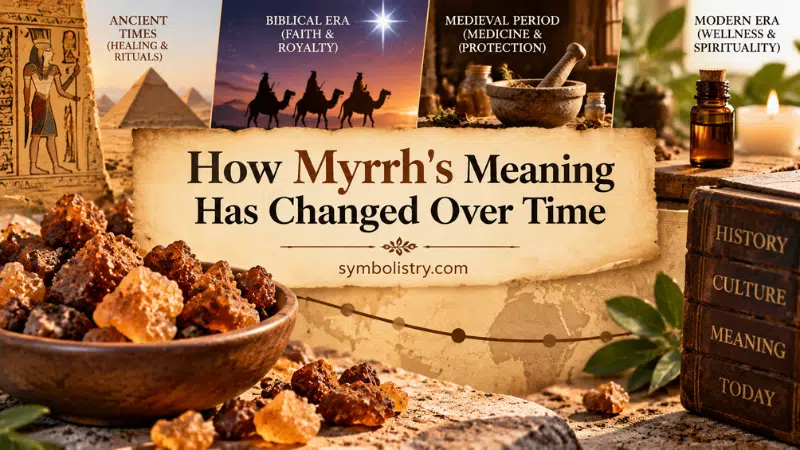
Myrrh began as a valuable natural material whose uses were practical, ceremonial, and commercial.
Its meaning developed through repeated human use.
When people burned it during rituals, it became associated with sacred space. When they used it as perfume, it became connected with beauty and luxury. When it was used around burial, it became connected with mourning and mortality.
Religious traditions then incorporated these existing associations into larger stories.
Christianity gave myrrh a particularly recognizable symbolic role through the Magi and the burial traditions surrounding Jesus.
Modern American culture has simplified some of these meanings.
For many people today, “myrrh” immediately means one of the three gifts of the Magi. Others know it as an incense or fragrance ingredient.
The older meanings have not disappeared, but they are often encountered through these more familiar modern associations.
A Quick Guide to Myrrh’s Major Symbolic Meanings
| Context | Symbolic Meaning | Why It Became Associated | Modern U.S. Connection |
|---|---|---|---|
| Christianity | Sacrifice and mortality | Biblical and later Christian traditions | Christmas and Holy Week |
| Burial | Mourning and remembrance | Historical funerary use | Religious and historical contexts |
| Worship | Devotion and sacred space | Incense and ritual use | Churches and religious ceremonies |
| Fragrance | Beauty and luxury | Costly aromatic material | Perfume and personal care |
| Healing | Care and restoration | Historical medicinal use | Herbal and wellness culture |
| Trade | Value and rarity | Long-distance movement of resin | Ancient-history education |
FAQ About Myrrh Symbolism
Why is myrrh associated with Christmas?
Myrrh is associated with Christmas because it is one of the three gifts presented by the Magi in the Gospel of Matthew. Later Christian interpretation gave the gift additional significance connected with Jesus’ suffering and death.
What does myrrh symbolize spiritually?
In religious contexts, myrrh can represent devotion, sacred offering, sacrifice, mortality, and reverence. The specific meaning depends on the religious tradition and the setting in which myrrh is used.
Is myrrh a symbol of death?
Death and mourning are important associations, but myrrh is not exclusively a death symbol. Its historical uses also connect it with fragrance, worship, beauty, medicine, bodily care, and valuable trade.
Why did the Magi give Jesus myrrh?
The Gospel of Matthew identifies myrrh as one of the Magi’s gifts but does not explain why they selected it. Later Christian interpretation connected the gift with Christ’s future suffering and death.
What does myrrh symbolize in Christianity?
In Christian tradition, myrrh is commonly associated with sacrifice, suffering, mortality, and burial. These meanings developed partly from the appearance of myrrh in the Nativity story and its later association with Jesus’ burial.
What is the difference between myrrh and frankincense symbolism?
Frankincense is especially associated with worship, prayer, and sacred offerings, while myrrh developed stronger associations with sacrifice, mortality, burial, and bodily care. Both, however, have long histories as valuable aromatic resins used in religious and ceremonial settings.
Is myrrh used in modern American culture?
Yes. Americans encounter myrrh in Christian traditions, incense, perfumes, soaps, cosmetics, historical discussions, and some herbal or wellness products. Its cultural meaning varies depending on whether it is being used religiously, commercially, or as a historical botanical material.
Conclusion
Myrrh is a small resin with an unusually broad cultural history. Myrrh symbolism connects fragrance and worship with beauty, healing, mourning, sacrifice, mortality, and devotion because the material itself was used in many different parts of human life.
In modern American culture, its strongest association is with Christianity and the Christmas story of the Magi. Yet that familiar meaning rests on a much older history involving ancient trade, religious ceremonies, perfume, medicine, and funerary practices.
Understanding myrrh means looking beyond a single definition. Its significance comes from the many roles the resin has played and from the way those roles were transformed into symbols of faith, care, remembrance, and mortality.