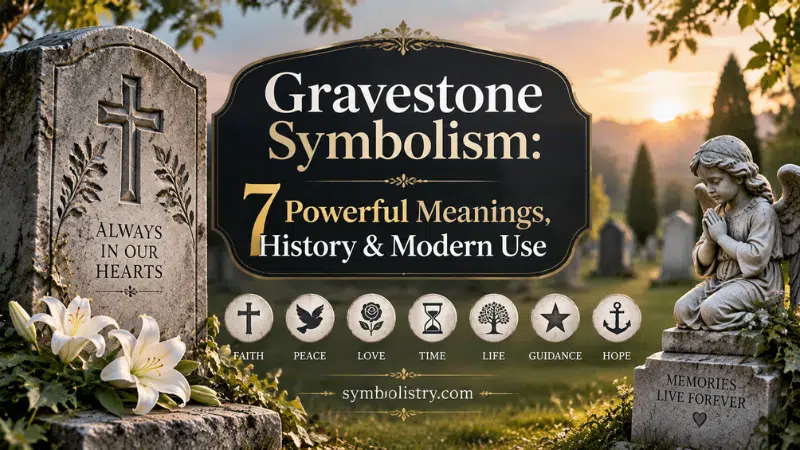
A gravestone is more than a marker identifying where someone is buried. Gravestone symbolism can communicate religious belief, family identity, remembrance, occupation, personality, hope, grief, and ideas about death and the afterlife. In American cemeteries, a single carved image can sometimes tell visitors something about a person’s life or the beliefs of the people who created the memorial.
Gravestones have changed considerably over time. Earlier markers often relied on religious imagery and formal inscriptions, while modern memorials may include photographs, personal quotations, hobbies, military references, flowers, animals, or other details chosen by the family. The result is a form of public remembrance that combines personal history with cultural tradition.
For someone walking through an older cemetery, these symbols can raise obvious questions. Why is there an angel on one grave and a lamb on another? What does an anchor mean? Why do some stones show clasped hands, broken columns, open books, or weeping willow trees?
The answers are not always fixed. A symbol can have a traditional meaning while also carrying a personal meaning specific to the deceased. Understanding the difference is essential when reading cemetery art.
Quick Answer
Gravestone symbolism commonly represents remembrance, religious belief, mortality, hope, family connection, and the character or life of the deceased in modern American cemeteries. Historically, carved symbols also expressed beliefs about death, resurrection, the afterlife, social identity, and the virtues associated with the person being remembered.
TL;DR
- Gravestones preserve names, dates, memories, beliefs, and family relationships.
- Angels often connect memorials with protection, heaven, or spiritual transition.
- Lambs commonly represent innocence, childhood, or Christian associations.
- Broken columns and flowers can express mortality and a life interrupted.
- Military, religious, and personal symbols identify different aspects of identity.
- Modern memorials increasingly combine traditional symbols with individualized designs.
What a Gravestone Is and Why Its Design Matters
A gravestone, headstone, or tombstone is a permanent marker associated with a burial place. In contemporary American usage, these terms are often used interchangeably, although historically they have had somewhat different meanings. Traditional grave markers may include a person’s name, birth and death dates, epitaph, religious imagery, decorative designs, or information about family relationships.
The physical form of the marker can also communicate something.
An upright stone gives space for inscriptions and carved imagery. A flat marker emphasizes the ground-level location of the grave. A larger family monument can identify several relatives and make family continuity part of the memorial’s design.
Materials matter as well. Granite is widely used for modern American monuments because it is durable and can be polished or carved. Older cemeteries may contain marble, slate, sandstone, limestone, or other materials depending on local resources and historical period.
The decoration is where symbolic interpretation becomes particularly interesting.
A cross may immediately suggest Christian faith. A military emblem can identify service. A flower may represent beauty, mortality, affection, or a particular relationship. An inscription may reveal more than the symbol itself.
This means a gravestone should be read as a combination of text, image, material, shape, and context rather than as a collection of isolated symbols.
The Ancient Roots of Gravestone Symbolism
The practice of marking graves is much older than modern cemeteries.
Ancient societies used stones, monuments, slabs, mounds, inscriptions, statues, and other structures to identify burial places and commemorate the dead. Funerary monuments could record names and achievements while also communicating religious beliefs about death and what might follow it.
The ancient stele became one important form of funerary art. Over time, grave markers increasingly incorporated inscriptions alongside decorative or symbolic imagery.
The meanings attached to these images depended heavily on cultural setting.
An Egyptian funerary image cannot automatically be interpreted according to a modern American symbolism chart. Likewise, a symbol found on an ancient Mediterranean tomb may have a religious or social meaning that differs from its later Christian interpretation.
Christian Europe contributed many symbols that eventually became familiar in American cemetery art. Crosses, angels, biblical imagery, flowers, heavenly motifs, and inscriptions about resurrection or eternal life became part of the visual language of Christian burial.
When European settlers established communities in North America, they brought burial customs and religious traditions with them. These practices changed over time as American communities developed their own cemetery styles.
By the nineteenth century, cemetery design in the United States could be highly elaborate. Large monuments, sculpted angels, symbolic plants, urns, obelisks, and detailed inscriptions appeared in many burial grounds.
The cemetery itself could become a place for mourning, reflection, family remembrance, and public memory.
What Gravestones Commonly Symbolize in the United States
In the United States, cemetery symbolism generally falls into several broad categories.
The first is remembrance. The grave marker preserves the person’s identity after death and provides a physical place where family and friends can return.
The second is religious belief. Crosses, angels, biblical quotations, stars, crescents, Jewish symbols, Buddhist imagery, and other religious elements can express the faith of the deceased or their family.
The third is mortality. Certain symbols acknowledge the temporary nature of human life. A broken column, extinguished flame, falling flower, or hourglass can emphasize the passage of time or the end of earthly life.
The fourth is hope. Symbols such as angels, heavenly light, ascending figures, flowers, and resurrection-related imagery may suggest an expectation of peace or continued existence.
The fifth is identity.
A gravestone may display military insignia, professional tools, fraternal symbols, sports references, musical instruments, animals, or hobbies. These details can tell visitors something about who the person was rather than simply stating when they lived.
These categories often overlap.
A cross may communicate both religious faith and hope. A flower may represent beauty and mortality. A military emblem may represent service, sacrifice, family pride, and national identity at the same time.
Common Gravestone Symbols and Their Meanings
Some symbols appear frequently enough that they have recognizable traditional associations. Still, their meanings should be treated as conventions rather than absolute rules.
| Gravestone Symbol | Common Meaning | Typical Associations | Important Context |
|---|---|---|---|
| Cross | Christian faith and resurrection | Belief, salvation, hope | Meaning depends on denomination and design |
| Angel | Spiritual protection or heaven | Guidance, guardianship, transition | Facial expression and pose can alter interpretation |
| Lamb | Innocence or Christian symbolism | Children, purity, Christ | Especially common in older cemetery art |
| Anchor | Hope and steadfastness | Faith, stability, maritime life | May also reflect occupation or naval service |
| Broken column | Life interrupted | Mortality, sudden death | Often interpreted in relation to the inscription |
| Weeping willow | Mourning and grief | Loss, sorrow, remembrance | Common in older funerary art |
These associations come from established funerary traditions, but no symbol should be interpreted without considering its specific cemetery and historical context. For example, an anchor may have symbolic associations with hope, but it could also simply indicate that the deceased worked at sea.
The Cross and Other Religious Symbols
Religious imagery is among the most recognizable forms of cemetery symbolism in America.
The Christian cross is perhaps the clearest example. On a gravestone, it can identify the deceased’s Christian faith while also referring to ideas such as resurrection, salvation, and hope beyond death.
The design matters.
A simple cross may function primarily as a statement of religious identity. A more elaborate cross surrounded by flowers, rays, angels, or inscriptions may communicate additional ideas.
Other religious traditions use their own symbols in American cemeteries.
A Jewish grave may incorporate a Star of David or Hebrew inscription. Muslim burial traditions have their own practices and conventions, and Buddhist, Hindu, and other communities may use distinctive imagery or inscriptions.
It is important not to force every grave into a Christian symbolic framework simply because Christian imagery is common in many American cemeteries.
Religious diversity is part of the American cemetery landscape, particularly in communities with long-established immigrant and faith traditions.
The safest interpretation is to identify the symbol within its own tradition rather than assuming that similar-looking imagery carries identical meaning across religions.
Angels, Wings, and the Idea of Spiritual Protection
Angels frequently appear in American funerary art.
An angel may be carved standing, kneeling, praying, pointing upward, holding a flower, or looking toward the grave. Each pose can suggest a somewhat different emotional message.
Generally, angels are associated with the spiritual world, protection, guidance, heaven, or the passage from earthly life to an afterlife.
An angel pointing upward can be interpreted as directing attention toward heaven. A praying angel may suggest mourning, devotion, or spiritual reflection.
Wings can reinforce the connection between the earthly and heavenly realms.
Yet angels also have an emotional function. A grieving family may choose an angel because the figure creates an image of care rather than focusing entirely on death.
On children’s graves, angel imagery may be especially poignant because it can express innocence and the belief that the child is under heavenly care.
Still, these interpretations are not universal. A sculpted angel might have been selected because the family liked the design rather than because they intended every traditional association.
Flowers, Plants, and the Symbolism of Mortality
Plant imagery is extremely common in funerary art.
Flowers are closely connected with life because they grow, bloom, fade, and disappear. That natural cycle makes them particularly suitable for memorial art.
Roses may suggest love or affection. Lilies have longstanding associations with purity and resurrection in Christian funerary traditions. Other flowers can carry meanings connected with beauty, remembrance, family, or the personality of the deceased.
The symbolism of plants can also depend on the period.
Older cemetery art may contain highly stylized floral motifs whose meaning was familiar to the people who commissioned them but is less obvious today.
The weeping willow is another well-known funerary image. Its drooping branches became associated with mourning and grief, making it especially suitable for cemetery landscapes and memorial stones.
Plants can therefore express both life and loss.
A flower on a gravestone does not necessarily mean that death is being portrayed as beautiful. It may instead acknowledge the contrast between a person’s life and its ending.
The Lamb and Symbolism of Innocence
A lamb carved on a gravestone is particularly important in older cemetery art.
The image can have Christian significance because the lamb is associated with Jesus Christ in Christian tradition. It can also represent innocence and purity.
For this reason, lamb imagery has often appeared on children’s graves.
The small animal creates a visual contrast with the seriousness of death. Rather than presenting the child through images of mortality, the memorial emphasizes gentleness and innocence.
This is one example of how the age of the deceased can change the meaning of a symbol.
A lamb on an adult’s gravestone might have a broader Christian meaning, while the same image on a child’s marker may strongly emphasize innocence.
Context is therefore essential.
The inscription, dates, surrounding imagery, and location within the cemetery can all help determine what the family intended.
Anchors, Ships, and Maritime Associations
The anchor has two major symbolic possibilities in cemetery art.
One is religious or philosophical: the anchor can represent hope, stability, steadfastness, or something that keeps a person grounded.
The other is biographical.
A person who worked as a sailor, fisherman, shipbuilder, naval officer, or other maritime professional might have an anchor carved onto the memorial because it reflects their occupation.
This dual meaning is a useful reminder that cemetery symbols can be both traditional and personal.
A visitor might recognize the anchor’s established symbolic associations while the family intended it primarily as a reference to the person’s working life.
The same principle applies to many occupational symbols.
A gravestone featuring musical instruments may indicate a musician. Tools may reference a trade. Books may suggest teaching, writing, education, or intellectual life.
The symbol can therefore function almost like a visual biography.
Broken Columns, Urns, and Other Symbols of Mortality
Some gravestone designs speak directly about the fragility of life.
A broken column is often interpreted as a life cut short or interrupted. The idea is straightforward: a complete column suggests strength and continuity, while a broken one represents something brought to an unexpected end.
An urn is another common funerary form.
Its history is tied to burial and classical funerary art, and its meaning can vary according to whether it is functioning as an actual container reference, a decorative element, or part of a traditional memorial composition.
Other historical funerary symbols include hourglasses, extinguished torches, skulls, bones, and various forms of mourning imagery.
These designs were more common in certain periods than they are today.
Modern American memorials generally favor a more personalized and less overtly morbid visual language, although older cemeteries preserve examples of earlier attitudes toward death.
The difference is revealing.
Earlier memorial art could openly depict mortality. Modern families often prefer symbols emphasizing memory, family, faith, achievement, or personality.
Hands, Hearts, and Family Connection
Human figures and body parts can make a gravestone feel particularly personal.
Clasped hands may represent farewell, friendship, marriage, or the bond between people. A heart can represent love, affection, or devotion.
Some hand motifs have specific historical traditions.
A pair of hands joined together may suggest a relationship that death has interrupted. Depending on the design, the hands may also communicate marriage or family connection.
Modern memorials frequently use hearts, names, photographs, and personal inscriptions to achieve a similar goal.
The emphasis is less on a standardized symbolic vocabulary and more on the relationship between the deceased and those who remain.
This reflects a broader shift in American memorial culture toward personalization.
Instead of simply identifying a person’s dates, families increasingly want the marker to communicate something recognizable about the individual.
Military Gravestones and Symbols of Service
Military identity is another important part of American cemetery symbolism.
Grave markers may contain military branch emblems, ranks, medals, service information, unit references, or other indicators of a person’s career.
These symbols do more than identify occupation.
They can communicate service, sacrifice, discipline, duty, and family pride.
American military cemeteries make this particularly visible because large numbers of markers can follow standardized designs. Standardization creates a strong visual sense of equality while inscriptions preserve individual identity.
The combination is significant.
The grave marker identifies a person as part of a larger institution while also preserving their name and personal history.
Military symbolism can also appear on private cemetery monuments, where families may choose emblems or inscriptions honoring a veteran’s service.
The meaning should not automatically be interpreted as a political statement. Often, it is simply a memorial acknowledgment of a person’s military experience.
Gravestone Symbolism and Personal Identity
Modern American gravestones increasingly function as miniature biographies.
A person may be remembered through a favorite quotation, photograph, occupation, hobby, sports affiliation, musical instrument, animal, landscape, or other personal reference.
This approach changes the role of cemetery symbolism.
Instead of asking only, “What does this symbol traditionally mean?” visitors can also ask, “What did this person care about?”
A golfer might have a golf-related image. A musician might be remembered with an instrument. A farmer might have agricultural imagery. A beloved pet may appear in a family memorial.
These details make the grave marker less abstract.
The person is remembered not simply as someone who died, but as someone who lived a particular life.
This trend is especially noticeable with modern engraving technology, which allows detailed photographs and custom artwork to be incorporated into memorials.
The gravestone becomes a place where identity continues after death.
How American Cemeteries Changed the Meaning of Memorials
American cemetery culture has changed significantly over the centuries.
Early burial grounds were often closely connected with churches and communities. Later cemetery movements created more landscaped environments where families could visit, walk, mourn, and reflect.
The nineteenth-century rural cemetery movement is particularly important in American history. Cemeteries increasingly became designed landscapes rather than simply burial grounds.
This affected memorial symbolism.
Monuments could be larger, more decorative, and more closely integrated with trees, paths, sculptures, and gardens.
The cemetery itself became part of the memorial experience.
Today, American cemeteries range from historic churchyards and rural burial grounds to large municipal cemeteries, veterans’ cemeteries, religious cemeteries, and modern memorial parks.
Different settings produce different visual languages.
A historic cemetery may preserve elaborate nineteenth-century symbols, while a contemporary memorial park may favor standardized granite markers and restrained designs.
Cross-Cultural Meanings of Grave Symbols
Grave symbolism is not exclusively American or Christian.
Different cultures have developed distinct approaches to burial, memorialization, and ancestral remembrance.
Some traditions emphasize written inscriptions. Others give greater importance to religious imagery, ancestral tablets, monuments, offerings, or architectural structures.
Jewish, Islamic, Christian, Buddhist, Hindu, and other burial traditions each have their own practices and expectations. Even within a single religion, local customs can differ considerably.
This makes universal symbolism charts unreliable.
A symbol’s meaning can change when it moves between cultures.
For example, flowers can appear in many funerary traditions, but the specific flowers, colors, and rituals surrounding them may differ. Likewise, a monument’s shape can have a particular historical meaning in one region and a different meaning elsewhere.
American cemeteries often reflect this diversity.
Immigration, religious pluralism, and changing communities have created a broad range of memorial practices across the country.
Emotional and Psychological Meaning of Gravestones
Gravestones serve an emotional purpose as well as a historical one.
For grieving families, a permanent marker can provide a physical place connected with the person who died. Visiting the grave can become part of mourning, remembrance, anniversaries, holidays, or family traditions.
The symbol on the stone can influence how that place feels.
An angel may create a sense of spiritual comfort. A photograph may make the person feel more present. A favorite quotation can preserve the individual’s voice. A flower can evoke affection.
Personal symbols may be especially important because grief is not identical for every person.
One family may want a traditional religious monument. Another may prefer something informal that reflects the deceased’s personality.
Neither approach is inherently more meaningful.
The purpose of the memorial is to create a representation that makes sense to the people who will remember the individual.
Gravestone Symbolism in Modern Memorial Design
Modern technology has expanded the possibilities for cemetery design.
Granite can be shaped and polished in many forms. Laser engraving can reproduce photographs and detailed images. Families can select custom fonts, artwork, landscapes, religious symbols, hobbies, and personal inscriptions.
This has made memorials more individualized.
A modern gravestone may look simple from a distance but contain extensive personal information when viewed closely.
Some markers use a traditional cross alongside a photograph. Others combine military service with family imagery. A person may be remembered through a favorite saying rather than a conventional epitaph.
This does not mean older symbolism has disappeared.
Traditional crosses, angels, flowers, religious phrases, and other motifs remain common. What has changed is the ability to combine those traditions with highly personal details.
The result is a memorial style that can be both conventional and individual.
Gravestones in Tattoos, Art, Decor, and Popular Culture
Gravestone imagery has also moved beyond cemeteries.
Tattoos may use gravestones to represent remembrance, mortality, grief, a specific person, or an interest in gothic imagery. A gravestone tattoo does not necessarily indicate sadness or a fascination with death; the meaning depends heavily on the wearer.
Artists and designers also use cemetery imagery to explore themes of memory, time, history, and mortality.
In popular culture, gravestones often appear in Halloween decorations, horror films, music imagery, video games, and gothic fashion.
This creates a distinction between funerary symbolism and entertainment symbolism.
A plastic tombstone placed in a yard for Halloween does not carry the same social function as a real memorial stone in a cemetery.
The imagery may look similar, but the context changes the meaning completely.
Common Misunderstandings About Gravestone Symbols
One common mistake is assuming that every symbol has one fixed definition.
Cemetery symbolism is more complicated than that.
A dove may suggest peace, the soul, Christianity, or remembrance. An anchor may indicate hope or a maritime profession. A flower may represent love, mourning, a particular person, or simply a decorative preference.
Another mistake is treating every unusual symbol as a secret code.
Some symbols are associated with fraternal organizations, military groups, religious traditions, or historical societies. Their meanings may require specialized knowledge, but that does not mean they contain a hidden message about the deceased.
It is also easy to assume that a symbol’s traditional meaning was always understood in exactly the same way.
Meanings evolve.
A design popular in the nineteenth century may appear on a modern gravestone even though few visitors recognize its original symbolism.
The most reliable approach is to consider the date, location, religious tradition, inscription, surrounding imagery, and biography of the deceased.
How Gravestone Symbolism Has Evolved
The biggest change in cemetery symbolism is the movement from standardized cultural imagery toward greater personalization.
Older gravestones often relied on shared visual conventions. Visitors from the same religious or cultural community could recognize familiar symbols without needing a written explanation.
Modern memorials still use those conventions, but families have more freedom to create individualized designs.
This reflects broader changes in American culture.
Personal identity has become increasingly important in memorialization. Families may want to show what made a person distinctive rather than relying solely on traditional religious imagery.
Technology has accelerated that change.
Photographs, detailed portraits, custom illustrations, and longer inscriptions allow a memorial to preserve more information than a small carved symbol could communicate.
Yet traditional symbolism remains useful because it provides a visual shorthand.
A cross can communicate faith immediately. A military emblem can communicate service. A heart can communicate affection.
Modern memorials therefore tend to add personal symbolism to older traditions rather than completely replace them.
How to Interpret a Gravestone Without Misreading It
When you encounter an unfamiliar gravestone symbol, avoid jumping immediately to a single conclusion.
Start with the inscription.
The person’s name, dates, epitaph, occupation, family relationships, and religious references may provide more information than the image itself.
Next, consider the surrounding symbols.
A flower beside an angel may have a different emphasis than the same flower carved next to a military emblem.
Then consider the cemetery.
A symbol found repeatedly throughout a particular historic cemetery may reflect a local or period-specific style rather than an individual preference.
Finally, consider the person’s life when that information is available.
A musical instrument on a memorial may have little symbolic ambiguity if the person was a musician. A ship or anchor becomes easier to understand when the deceased worked at sea.
This method prevents a common problem in symbolism writing: turning possibilities into certainties.
Gravestones are historical objects, but they are also personal documents. Their meanings should be interpreted carefully.
FAQ About Gravestone Symbolism
What does a broken column mean on a gravestone?
A broken column is commonly interpreted as a life interrupted or cut short. The symbol is particularly associated with funerary art in which architectural forms are used to represent mortality.
What does an anchor symbolize on a gravestone?
An anchor can represent hope, stability, steadfastness, or faith. It may also identify someone with a maritime occupation or naval background, so the person’s biography can help clarify the intended meaning.
What does a lamb on a gravestone mean?
A lamb can symbolize innocence, purity, and Christian belief. It is especially associated with children’s graves in older cemetery art, although it can also carry broader religious meaning.
What does an angel on a gravestone symbolize?
An angel commonly represents spiritual protection, guidance, heaven, or a connection between earthly life and the spiritual world. The angel’s pose can add meaning, such as prayer, mourning, or looking toward heaven.
What is the most common symbol found on a gravestone?
Religious crosses are among the most recognizable symbols on gravestones in many American Christian cemeteries. However, there is no single symbol that appears on every cemetery marker, and practices vary by religion, region, and period.
Do gravestone symbols always have a hidden meaning?
No. Some symbols have established cultural or religious associations, while others are chosen mainly for decoration or personal preference. The most accurate interpretation combines traditional symbolism with the history and circumstances of the individual memorial.
Why do gravestones have flowers carved into them?
Flowers can represent love, remembrance, beauty, mortality, or religious ideas about purity and resurrection. The specific flower matters, but the historical period and surrounding imagery should also be considered.
Conclusion
Gravestone symbolism provides a visual language for remembering people after death. Crosses, angels, lambs, anchors, flowers, broken columns, military emblems, and personal images can communicate faith, hope, love, service, mortality, identity, and family connection.
The meaning of a particular symbol, however, depends on more than a standard definition. Its historical period, cultural tradition, religious setting, surrounding imagery, inscription, and connection to the deceased can all change how it should be understood.
Modern American memorials show how flexible this tradition has become. Families continue to use familiar funerary symbols while adding photographs, hobbies, occupations, quotations, and other details that make each person’s memorial distinctive. A gravestone ultimately does more than mark a burial place: it preserves a small part of the story of the person remembered there.