Introduction
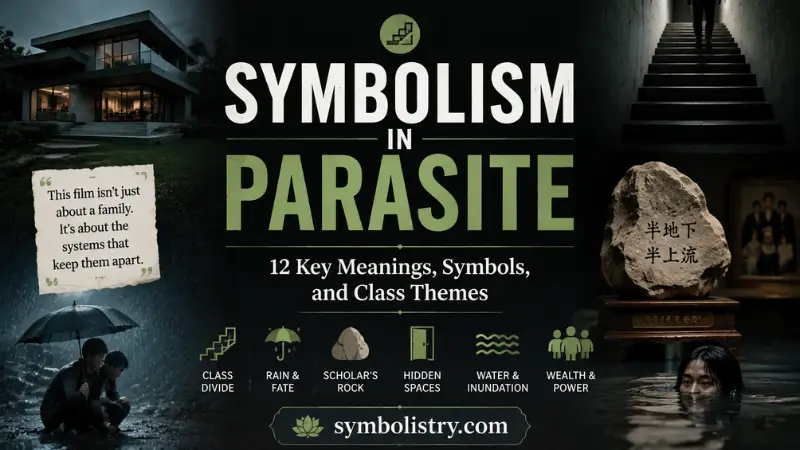
Symbolism in Parasite is central to understanding Bong Joon-ho’s 2019 South Korean film. Beneath its dark humor and suspense, the movie uses houses, stairs, weather, food, objects, and physical spaces to explore wealth, poverty, ambition, and social division.
The story follows the Kim family as they gradually enter the wealthy Park family’s household through a series of carefully planned deceptions. What begins as an opportunity for employment becomes increasingly complicated as the family discovers another hidden layer of the house.
Much of the movie’s meaning is communicated visually. Characters move up and down stairs, wealthy and poor families experience the same rain differently, and ordinary objects acquire new meanings as the story progresses.
For American viewers, the film’s class themes can feel familiar even though the story is specifically rooted in South Korean society. Housing insecurity, economic inequality, service work, educational opportunity, and the desire for upward mobility all provide points of comparison.
Quick Answer
Symbolism in Parasite commonly represents class inequality, social hierarchy, economic insecurity, and the difficult pursuit of upward mobility. Stairs, rain, smell, the scholar’s rock, the Park house, and underground spaces turn these themes into visible symbols that reveal how wealth shapes everyday life.
TL;DR
- Stairs represent movement through a rigid social hierarchy.
- The Park house symbolizes wealth, privacy, and privilege.
- The semi-basement reflects economic insecurity and social marginalization.
- Rain shows how wealth changes the consequences of disaster.
- The scholar’s rock represents ambition, hope, and uncertain mobility.
- Smell becomes an invisible marker separating social classes.
Why Symbolism in Parasite Is Essential to the Story
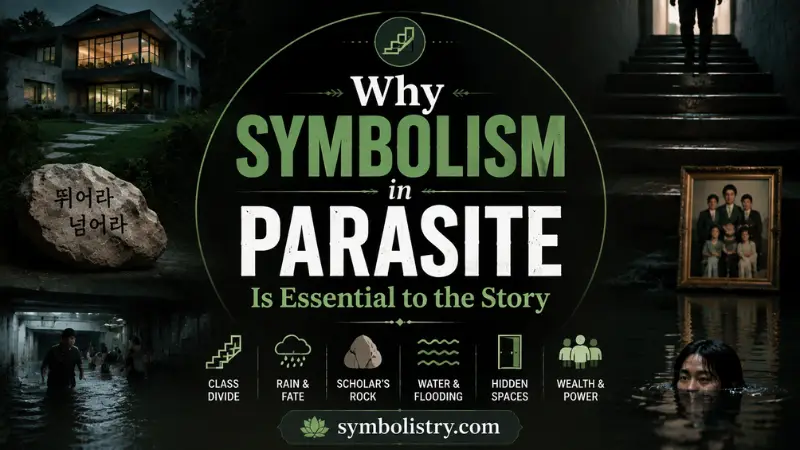
The movie does not rely on dialogue alone to explain inequality. Instead, symbolism in Parasite develops through repeated visual patterns that allow viewers to understand the characters’ social positions without constant explanation.
The most important pattern is vertical movement. The wealthy Parks live in an elevated, spacious home, while the Kims live in a semi-basement apartment. Other characters occupy an even lower underground space.
This creates a physical hierarchy. The characters are not simply separated by money; they are separated by floors, doors, windows, stairs, and access.
The film’s visual structure also explains why seemingly ordinary moments become meaningful. Walking into a house can represent entering another social world. Walking down a staircase can mean returning to economic reality.
Rather than giving viewers one symbol with one definition, Bong connects several images together. The result is a network of meanings in which architecture, objects, weather, and human behavior reinforce one another.
The Stairs Symbolize Social Class and Upward Movement
The stairs are probably the clearest example of symbolism in Parasite. Characters repeatedly move upward toward wealth or downward toward poverty, making physical movement reflect social hierarchy.
When Ki-woo first enters the Park family’s home, he travels upward into a large and comfortable environment. The movement suggests opportunity because his new job gives him access to a lifestyle far removed from his family’s apartment.
However, his position does not actually become equal to that of the Parks. He enters their home as an employee, not as an owner or member of the family.
The same pattern continues as other members of the Kim family find positions within the household. They climb socially for a short period, but their new positions remain dependent on the Park family.
The long descent after the rainstorm is particularly important. The Kims leave the wealthy neighborhood and walk downward through the city until they reach their flooded home.
The journey turns stairs into more than scenery. They become a visual map of economic inequality.
The Semi-Basement Represents Economic Insecurity
The Kim family’s semi-basement apartment provides another important layer of symbolism in Parasite. It is positioned between the street and a fully underground space, reflecting the family’s uncertain place in society.
The apartment has a window, but the view is limited. People outside can be seen, yet the Kims remain physically below street level.
That position mirrors their economic circumstances. They are not completely excluded from society, but they have little financial security and limited control over their future.
Their dependence on temporary jobs reinforces this instability. The family has skills and intelligence, but those qualities do not automatically translate into stable economic opportunity.
The semi-basement therefore represents more than poverty. It suggests a precarious position in which a person can remain close to improvement while still being vulnerable to falling further.
This becomes especially significant when the apartment floods. Their low position is not just symbolic; it creates a direct physical vulnerability.
The Park House Symbolizes Wealth and Privilege
The Park house is one of the strongest images in symbolism in Parasite. Its clean lines, large windows, open rooms, garden, and carefully designed interior contrast sharply with the Kims’ cramped home.
The house initially appears almost like a reward. Once the Kim family gains access to it, they can temporarily experience comfort that was previously unavailable to them.
But the house also exposes how privilege works. The Parks can move through their home without thinking about many of the people whose labor keeps it functioning.
The driver, tutor, housekeeper, and other workers make the family’s lifestyle possible. Their labor is necessary, but their personal lives remain largely outside the Parks’ attention.
The architecture reinforces this separation. The Parks have private rooms and extensive space, while workers enter specific areas only when their jobs require it.
The home therefore symbolizes both material comfort and social distance.
The Hidden Bunker Represents Invisible Poverty
One of the biggest shifts in symbolism in Parasite occurs when the hidden bunker beneath the Park house is revealed.
Before this discovery, viewers may think the story has only two economic levels: the wealthy Parks and the struggling Kims. The bunker reveals a third level occupied by someone in an even more desperate position.
Geun-sae has been living secretly underground because of his financial problems. His existence turns the house into a vertical model of society.
At the top are the wealthy owners. Below them are workers and struggling families. Beneath them is someone almost completely invisible.
The bunker also demonstrates that poverty can be hidden behind respectable architecture. The Park family lives in a beautiful house without knowing what is happening beneath it.
This makes the underground room a symbol of people who exist within the same society but remain outside the awareness of those with greater privilege.
The Scholar’s Rock Represents Ambition and Uncertain Hope
The scholar’s rock is another important part of symbolism in Parasite. Min-hyuk gives the stone to Ki-woo as a gift associated with prosperity and good fortune.
Ki-woo quickly becomes emotionally attached to it. He treats the object as though it carries a promise that his family’s financial situation can change.
The rock therefore represents ambition. It gives Ki-woo something concrete to associate with his desire for a better future.
Yet its meaning changes dramatically. Later, the same object becomes connected to violence and physical danger.
That transformation makes the rock an ironic symbol. Something that appeared to promise prosperity becomes a burden and a weapon.
Its changing role suggests that ambition can motivate people, but ambition can also become dangerous when social advancement is treated as an individual problem rather than a structural one.
The rock’s physical weight is especially fitting. Ki-woo carries the object while pursuing a dream that may itself become increasingly difficult to carry.
Rain Reveals Unequal Consequences
Rain is one of the most memorable examples of symbolism in Parasite because the same weather event has completely different consequences for the two families.
For the Parks, the rain ruins an outdoor camping trip. They return home and quickly reorganize their plans.
For the Kims, the storm is devastating. Their semi-basement floods, belongings are destroyed, and they lose the security they had.
The difference demonstrates that natural events do not affect everyone equally.
Wealth provides protection. A large house on safer ground can turn a dangerous storm into an inconvenience, while vulnerable housing can turn the same storm into a disaster.
The rain therefore symbolizes unequal exposure to risk.
It also challenges the idea that everyone lives under the same conditions simply because they share the same city. The weather is technically the same, but its consequences depend heavily on economic position.
Smell Represents an Invisible Social Boundary
Smell is one of the most personal forms of symbolism in Parasite. Clothing can be changed, speech can be adjusted, and a person’s job can be presented differently, but smell becomes a marker that the Kims cannot easily control.
Mr. Park notices a particular smell associated with Ki-taek. His comments are especially humiliating because Ki-taek is already aware of the social distance between himself and his employer.
The smell becomes an invisible boundary.
The Kims can successfully imitate middle-class or professional behavior, but they cannot completely erase the material conditions associated with their lives.
This makes smell a symbol of class identity that operates beneath conscious behavior. It also explains why Ki-taek becomes increasingly resentful.
He can accept being treated as an employee, but being reminded that he belongs to a different social category attacks his dignity.
Food Represents Labor and Unequal Comfort
Food contributes another layer to symbolism in Parasite. The wealthy family can experience carefully prepared meals as part of normal domestic life, while the Kims frequently encounter food through work and financial necessity.
The contrast becomes particularly clear when workers prepare meals inside the Park home. What looks effortless to the family requires someone else’s time and labor.
Food therefore becomes connected to privilege.
The Parks are not shown struggling to obtain or prepare basic meals. Their household staff handles many practical tasks, allowing them to experience domestic comfort without seeing all the work behind it.
The Kims, meanwhile, understand food from a different position. Their relationship with meals is influenced by money, employment, and scarcity.
The kitchen becomes a place where class differences are quietly reproduced every day.
The Peach Symbolizes Vulnerability and Manipulation
The peach is a surprisingly important object in symbolism in Parasite because it becomes part of the Kims’ plan to remove Moon-gwang from the household.
Her allergy gives them an opportunity to manipulate the Park family’s perception of her health.
The peach itself is ordinary, but the characters turn it into a tool of deception.
This illustrates one of the film’s recurring ideas: ordinary objects can become dangerous when people are placed under economic pressure.
The Kims’ plan is clever, but it is also morally troubling. Moon-gwang is not wealthy or powerful; she is another worker trying to protect her position.
By targeting her, the Kims demonstrate how competition among economically vulnerable people can become more intense than solidarity.
The peach therefore represents both vulnerability and the willingness to exploit it.
The “Ghost” Represents Hidden Reality
Da-song’s belief that he saw a ghost in the Park house initially seems like a child’s imagination. Later, the audience learns that the strange figure was actually connected to someone living beneath the home.
This creates another layer of symbolism in Parasite. The “ghost” represents a reality that the household does not understand because it has been hidden from them.
To Da-song, the figure is frightening and mysterious. To the audience, the later revelation makes the image more tragic.
The idea also fits the film’s treatment of invisible poverty. People can be physically close while remaining socially unseen.
The Park family’s wealth allows them to live comfortably without questioning what may exist beneath their daily routines.
The ghost image therefore becomes a visual representation of the consequences of ignoring people who exist outside one’s immediate social world.
Clothing Shows the Performance of Social Class
Clothing is another subtle part of symbolism in Parasite. The Kim family changes its appearance as members take jobs within the Park household.
These changes help them appear more professional and trustworthy.
The strategy works because social class is communicated through signals. Clothing, language, manners, occupation, and education can all influence how people are perceived.
But the performance has limits.
The Kims can dress differently, yet their financial vulnerability remains. Their identities are constructed carefully, but the constant risk of exposure creates tension.
The film therefore asks whether social mobility can be achieved simply by learning the behavior associated with another class.
Its answer appears uncertain. A person may enter a wealthy environment without receiving the security or respect associated with wealth.
Doors and Windows Represent Access and Exclusion
The doors and windows throughout the film contribute to symbolism in Parasite by separating people who occupy the same physical environment.
The Park house contains many private spaces. Workers can enter some areas but are not treated as people with equal access to the household.
The Kims’ apartment window works differently. It places them close to street life while reminding them that their view is limited.
Windows can provide a connection to the outside world, but they can also reinforce separation.
Doors have a similar function. A closed door can protect privacy, hide information, or keep someone out.
These boundaries become especially significant as secrets accumulate inside the Park house. The more the characters hide from one another, the more important physical barriers become.
The Garden Party Represents a Carefully Maintained Illusion
The garden party is an important example of symbolism in Parasite because it presents an image of normal upper-class life immediately before the story reaches its violent climax.
The setting is bright and social. Guests gather, food is served, and the Park family expects the event to remain pleasant.
Yet beneath this surface, multiple crises are developing.
The Kims are dealing with the consequences of the flood. The hidden residents of the house remain part of the unfolding conflict. Ki-taek is increasingly affected by Mr. Park’s treatment of him.
The garden party therefore becomes a stage.
Everyone is expected to perform a role: employer, employee, guest, parent, child, entertainer, or servant.
The contrast between appearance and reality is central to the film. A beautiful setting can temporarily conceal conflict, but it cannot permanently eliminate it.
Social Mobility Is the Film’s Central Question
Many examples of symbolism in Parasite ultimately return to one question: can people genuinely move from one social class to another?
Ki-woo initially believes that education and opportunity can help him rise. His tutoring position gives him access to a wealthy household, and his family members follow him into the same environment.
But the arrangement is unstable.
Their success depends on deception and on maintaining boundaries created by the Park family. They are allowed inside the house because they perform useful roles, not because the social hierarchy has disappeared.
The scholar’s rock reinforces this problem. Ki-woo sees wealth as a destination that might eventually be reached through determination.
The ending complicates that dream by presenting his imagined future as difficult to distinguish from fantasy.
The film does not say that individual effort has no value. Instead, it questions whether effort alone can overcome structural inequality.
How the Film’s Symbols Relate to American Culture
For American audiences, symbolism in Parasite can provide a useful way to think about class differences without assuming that South Korean society and American society are identical.
The film’s themes connect with familiar American concerns such as housing costs, economic insecurity, service employment, educational inequality, and inherited wealth.
The difference between a safe home and an insecure home is particularly easy for American viewers to recognize. So is the experience of working inside another person’s household while remaining economically separate from them.
The film can also be connected to American discussions about social mobility. The idea that hard work should allow someone to improve their circumstances is deeply familiar in the United States.
Parasite complicates that belief by showing what happens when opportunities are scarce and different groups are competing for the same limited advantages.
However, the film should not be treated as a literal explanation of American class structures. Its cultural setting remains specifically Korean, and its architecture, housing, employment relationships, and social references belong to that context.
The strongest interpretation is comparative: the movie gives American viewers a framework for thinking about inequality while still respecting its original setting.
Emotional Meaning Behind the Film’s Symbols
The emotional side of symbolism in Parasite is closely tied to humiliation, hope, fear, resentment, and uncertainty.
Ki-woo’s ambition creates hope. Ki-taek’s experiences with Mr. Park create resentment. The flooded apartment creates helplessness. The bunker produces fear and desperation.
These emotions are not separate from class. They develop because the characters have different levels of economic security.
A wealthy person can recover from an inconvenience more easily than someone who has almost no financial protection.
That difference shapes how characters interpret the same events.
The film’s symbols make these emotional differences visible. Rain becomes loss. Stairs become exhaustion. Smell becomes humiliation. The house becomes both opportunity and exclusion.
This is why the symbolism feels connected to the characters rather than merely decorative.
Common Misunderstandings About Symbolism in Parasite
One common mistake is to assume that every object has one permanent meaning.
The scholar’s rock, for example, begins as a symbol of prosperity but later becomes associated with danger. The rain creates inconvenience for one family and devastation for another.
Another misunderstanding is that the film simply portrays the wealthy as evil and the poor as innocent.
The story is more complicated. The Kims are victims of economic hardship, but they also deceive and manipulate other vulnerable people. The Parks are privileged, but they are not presented as purely monstrous characters.
This complexity is essential to symbolism in Parasite because the film is interested in systems as much as individuals.
The title itself is deliberately ambiguous. Viewers can ask whether the Kims are parasites, whether the Parks depend on workers, or whether both groups participate in a relationship where each benefits from someone else.
That ambiguity prevents the movie from offering an easy moral conclusion.
Major Symbols at a Glance
| Symbol | Main Meaning | Class Theme | Emotional Effect |
|---|---|---|---|
| Stairs | Social hierarchy | Rising and falling between classes | Tension |
| Semi-basement | Precarious poverty | Limited security | Vulnerability |
| Park house | Wealth and privilege | Separation from hardship | Comfort and distance |
| Scholar’s rock | Ambition and hope | Desire for mobility | Hope and irony |
| Rain | Unequal risk | Wealth changes consequences | Loss |
| Bunker | Hidden poverty | Social invisibility | Fear |
Why Symbolism in Parasite Remains Relevant
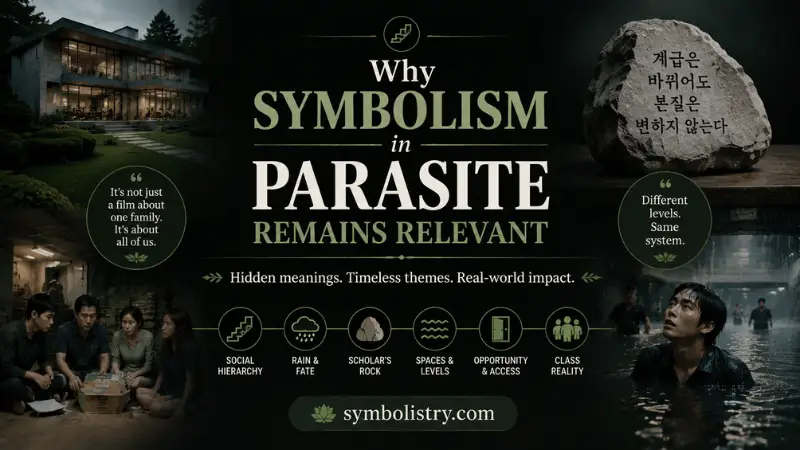
The continued interest in symbolism in Parasite comes from the way the movie connects large social questions with familiar physical objects.
A staircase is ordinary. A house is ordinary. Rain, food, clothing, and a stone are ordinary.
Bong Joon-ho makes those things meaningful by placing them inside relationships shaped by wealth and dependency.
The film also remains relevant because economic inequality has not disappeared. People continue to debate housing affordability, wages, education, employment security, and the possibility of moving into a higher economic class.
The symbols provide a language for those questions.
Rather than simply telling viewers that inequality exists, the movie makes inequality visible through where people sleep, where they walk, what they smell, what they eat, and how safely they can respond to disaster.
Frequently Asked Questions
What does the rain symbolize in Parasite?
The basement symbolizes hidden poverty, desperation, and people pushed outside ordinary social visibility. Its existence beneath the Park home also reinforces the movie’s vertical representation of economic class.
What does the rain symbolize in Parasite?
The rain symbolizes unequal vulnerability. The wealthy Parks can treat the storm as an inconvenience, while the Kims experience the same weather as a disaster because their housing provides much less protection.
What does the scholar’s rock symbolize?
The scholar’s rock symbolizes prosperity, ambition, and Ki-woo’s hope that his family can improve its financial position. Its later connection with violence makes the object an ironic reminder that ambition can carry unexpected consequences.
What do the stairs symbolize in Parasite?
The stairs represent movement through the social hierarchy. Characters who climb toward the Park family’s home gain temporary access to wealth, while downward movement repeatedly brings the Kim family back toward economic insecurity.
What is the main symbolism in Parasite?
The central symbolism in Parasite concerns class inequality, economic insecurity, and social hierarchy. The film expresses these ideas through architecture, vertical movement, weather, objects, smell, and hidden spaces.
Why is the movie called Parasite?
The title is intentionally open to interpretation. The Kims depend on the Parks’ wealth, but the Parks also depend heavily on workers whose labor supports their comfortable lifestyle, making the relationship between “host” and “parasite” deliberately complicated.
Why is smell important in Parasite?
Smell becomes a class marker that the Kims cannot easily disguise. Mr. Park’s reaction to Ki-taek’s smell turns an ordinary physical characteristic into a source of humiliation and social separation.
Conclusion
Symbolism in Parasite turns class inequality into something viewers can physically see and feel. Symbolism in Parasite uses stairs to represent hierarchy, the semi-basement to represent insecurity, the Park house to represent privilege, rain to expose unequal risk, and the bunker to reveal the people hidden beneath comfortable appearances.
The film’s symbolism in Parasite becomes most effective when these images are considered together. The symbolism in Parasite shows that economic class is not only about money; it can determine where people live, how they are treated, what risks they face, and how much freedom they have to recover from failure.
The stairs are central to the symbolism in Parasite because characters repeatedly move upward or downward according to their social position. The semi-basement and the Park family’s elevated home make the symbolism in Parasite especially clear: physical space becomes a visual map of class.
Rain adds another layer to the symbolism in Parasite. For one family, the rain appears almost beautiful, while for another, it causes devastating damage. This contrast makes the symbolism in Parasite a commentary on how the same event can produce completely different consequences depending on wealth.
The hidden bunker also strengthens the symbolism in Parasite by showing that poverty can exist outside ordinary public view. What appears to be a comfortable and orderly home contains another world beneath it, making the symbolism in Parasite closely connected to hidden inequality and social invisibility.
Ultimately, symbolism in Parasite leaves viewers with an uncomfortable question about social mobility: how much can individual ambition accomplish when the structure itself keeps people separated? The symbolism in Parasite gives that question a visual form, showing how class boundaries can become part of everyday space, movement, relationships, and survival.