
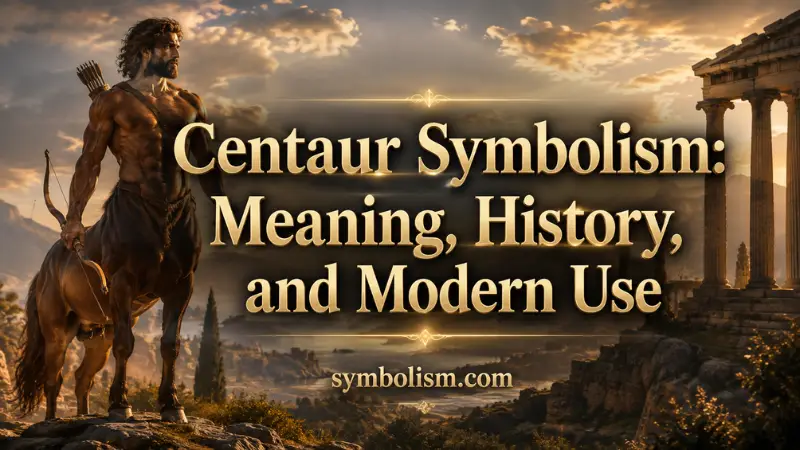
A creature with a human torso joined to the body of a horse is difficult to mistake. Centaur symbolism grows from that unusual combination: human thought and animal force occupying the same body.
For ancient Greek audiences, however, centaurs did not carry one simple message. Many stories portrayed them as unruly beings associated with drunkenness, aggression, and life beyond civilized boundaries. Chiron, the famous wise centaur, represented almost the opposite qualities—learning, healing, mentorship, and self-control. Ancient artworks preserve both sides of this tradition.
That contrast remains important in the United States today. A centaur in a tattoo, fantasy story, game, illustration, or zodiac-inspired design may suggest strength and freedom, but it can also represent the difficult balance between reason and instinct.
Quick Answer
Centaur symbolism commonly represents the balance between human intelligence and untamed instinct in modern American culture, often suggesting strength, freedom, duality, or inner conflict. Historically, Greek traditions also connected centaurs with wilderness and disorder, while Chiron represented wisdom, healing, teaching, and disciplined knowledge.
TL;DR
- Centaurs combine human reason with animal strength and instinct.
- Greek myths often portrayed ordinary centaurs as wild and disorderly.
- Chiron represented wisdom, healing, education, and responsible strength.
- American interpretations often emphasize freedom, duality, and individuality.
- Tattoos can represent self-mastery, independence, or competing sides of personality.
- Fantasy culture has made centaurs more varied and morally complex.
What a Centaur Represents at a Glance
The symbolic meaning of a centaur depends heavily on which version of the creature is being referenced.
An aggressive centaur from the battle myths conveys something very different from Chiron teaching Achilles. Modern images often combine these traditions rather than keeping them strictly separate.
| Context | Meaning in the USA | Common Associations | Notes |
| General centaur | Duality | Reason, instinct, strength | Human and animal qualities combined |
| Wild centaur | Uncontrolled impulses | Anger, appetite, chaos | Closely tied to Greek battle myths |
| Chiron | Wisdom and guidance | Healing, teaching, mentorship | A major exception among centaurs |
| Tattoo imagery | Personal balance | Freedom, identity, self-control | Meaning varies by individual |
| Fantasy culture | Independent nature | Wilderness, archery, adventure | Often less negative than ancient portrayals |
| Zodiac imagery | Exploration and ambition | Sagittarius, movement, aiming forward | Not every centaur image represents Sagittarius |
The centaur is therefore better understood as a symbol of tension between different forces than as a symbol with one permanent definition.
What Centaurs Look Like and Why the Hybrid Form Matters
The familiar centaur has the head, arms, and torso of a human attached to a horse’s body and four legs. Ancient Greek artists did not always depict the creature in exactly the same way. Some early examples experimented with how the human and equine parts should connect.
A Greek bronze group dated to the middle of the eighth century BCE already shows a human fighting a centaur, demonstrating that the hybrid creature had entered Greek visual culture very early.
Symbolically, the body itself invites comparison between two aspects of existence. The human half can suggest language, judgment, culture, and conscious choice. The horse half can suggest physical movement, appetite, speed, wilderness, and bodily instinct.
Modern viewers frequently interpret this combination psychologically: the centaur becomes an image of a person trying to live intelligently without denying the physical and instinctive parts of human nature.
That reading is modern rather than a single formal doctrine inherited from ancient Greece, but it fits the visual tension built into the creature.
Ancient Greek Origins of Centaur Meaning
Centaurs belong primarily to Greek mythology and were especially associated with Thessaly and mountainous or uncultivated landscapes.
Ancient traditions did not preserve one perfectly consistent origin story. Different writers and local traditions explained the creatures differently. The broader mythology nevertheless positioned many centaurs at the edge of organized human society rather than comfortably inside it.
Their early appearance in Greek art is significant. Centaurs were already being shown in combat during the Geometric period, and they later became common in pottery, sculpture, and monumental architecture.
This setting helped establish an enduring symbolic contrast. Greek heroes and communities represented organized social life; centaurs could represent the impulses that threatened to break its rules.
Yet Greek mythology rarely leaves symbols completely uncomplicated. The existence of Chiron prevented the entire race from being reduced to simple monsters.
The Centauromachy and the Conflict Between Order and Chaos
One of the most influential centaur stories is the Centauromachy, the battle between centaurs and the Lapiths.
In the traditional story, centaurs attend a Lapith wedding. After drinking excessively, violence erupts, including an attempted abduction of the bride. The celebration turns into a battle.
Greek artists repeatedly depicted the episode.
Centaur-Lapith combat appeared in prominent fifth-century BCE art, including architectural programs associated with major Greek sanctuaries and the Parthenon. The Metropolitan Museum of Art describes centaurs in this artistic tradition as forces of chaos and barbarism opposed to civilization.
This explains several enduring negative meanings:
- failure of self-control
- drunken aggression
- violation of social boundaries
- uncontrolled appetite
- conflict between civilization and wilderness
The point was not simply that horses were wild. The centaur was dangerous because intelligence and physical power existed together without sufficient restraint.
That makes the creature more psychologically complicated than an ordinary monster.
Chiron and the Wise Side of Centaur Symbolism
Chiron changes almost everything.
Rather than behaving like the violent centaurs of the wedding battle, Chiron was remembered as learned, just, and capable of educating heroes. Classical traditions connected him with figures such as Achilles and Jason, while healing traditions associated him with the education of Asclepius.
Because of this role, Chiron can represent:
Mentorship. Knowledge becomes valuable when it is passed to someone else.
Healing. Chiron is strongly associated with medicine and instruction in healing traditions.
Discipline. His animal strength does not control his behavior.
Wisdom gained through experience. Chiron is portrayed as someone heroes seek out for guidance.
Responsible power. Physical capability and knowledge work together instead of competing.
Modern symbolism sometimes calls Chiron the model for a “wounded healer,” especially in psychological or astrological language. That interpretation builds on the myth of an immortal healer who suffered from an incurable wound, although modern therapeutic uses of the phrase should not be mistaken for an ancient Greek psychological system.
Why the Human-Horse Combination Suggests Duality
Hybrid creatures naturally attract symbolic interpretations because their bodies cross categories.
With a centaur, the contrast is unusually readable. The upper body resembles the reasoning human observer; the lower body belongs to a strong, fast animal.
In modern symbolic use, this can represent competing dimensions of personality:
reason and desire
discipline and spontaneity
society and wilderness
intellect and physicality
restraint and freedom
The centaur does not necessarily demand that one side defeat the other.
For many contemporary viewers, its more useful meaning is integration. A healthy person does not eliminate instinct, emotion, or physical desire. Instead, those forces are directed by judgment.
This is one reason centaur imagery works well in personal art. The creature visually expresses the idea of being composed of different tendencies without having to choose only one identity.
Freedom, Wilderness, and Independence
The horse body gives modern centaur imagery a strong sense of movement.
In American visual culture, horses already carry associations with open landscapes, speed, independence, and life beyond crowded cities. When combined with a human figure, those associations can make the centaur appear self-sufficient and difficult to confine.
This is noticeably different from some ancient interpretations.
An ancient Greek scene could use the centaur’s distance from civilized society as a warning. A modern American viewer may interpret the same distance positively as independence, nonconformity, or freedom from restrictive expectations.
Context decides which reading works.
A centaur running through a forest may communicate liberation. A centaur attacking wedding guests communicates the danger of uncontrolled behavior. A calm Chiron teaching a student communicates disciplined knowledge.
The creature’s posture and surrounding story matter as much as its species.
Strength Without Self-Control Versus Strength With Purpose
One of the clearest ways to understand centaur meaning is to compare power without discipline with power guided by intelligence.
The violent centaurs have physical strength, but that strength becomes destructive because appetite controls behavior.
Chiron also possesses the centaur’s physical nature, yet his defining qualities are judgment, learning, and guidance.
The contrast creates a useful modern interpretation: strength itself is morally neutral. What matters is what directs it.
For that reason, a centaur can symbolize either uncontrolled masculinity and aggression or mature control over physical and emotional impulses.
It would be inaccurate to claim that every centaur traditionally represented masculinity. The broader symbolic lesson concerns regulation of desire and power, not one gender alone.
What Centaurs Commonly Mean in the United States
Most Americans encounter centaurs through mythology classes, fantasy books, movies, games, astrology, illustration, or online art rather than through Greek religious practice.
As a result, contemporary meanings are often more positive and individualized than the older battle symbolism.
A modern centaur may represent someone who feels:
independent but thoughtful
civilized but close to nature
physically strong yet intellectually curious
divided between responsibility and freedom
uncomfortable fitting into a single category
Fantasy has also softened the old idea that centaurs must be violent outsiders. Modern fictional centaurs may appear as warriors, scholars, forest guardians, archers, healers, teachers, or independent communities.
This wider range gives the symbol more flexibility than it possessed in many classical combat scenes.
Centaurs and Sagittarius Are Related but Not Identical
Centaurs are often connected with Sagittarius, the zodiacal archer.
Modern zodiac artwork frequently depicts Sagittarius as a centaur drawing a bow. Because of that imagery, centaur designs can acquire Sagittarian themes such as movement, exploration, independence, ambition, and aiming toward a distant goal.
However, a centaur should not automatically be interpreted as Sagittarius.
A centaur without a bow may simply reference Greek mythology, Chiron, wilderness, fantasy culture, or human-animal duality. Likewise, historical interpretations of constellations and mythological figures developed through multiple traditions rather than one perfectly uniform story.
The bow and arrow are the strongest visual clues that a modern centaur image is intended as zodiac symbolism.
Centaur Tattoo Meaning
Centaur tattoos can carry unusually personal meanings because the creature already combines contrasting qualities.
A person may choose one to represent self-mastery—the ability to acknowledge strong instincts without being ruled by them.
Others use centaur imagery for independence, physical strength, adventure, freedom, or a sense of belonging more comfortably in nature than in conventional social settings.
A Chiron tattoo changes the emphasis. It may represent mentorship, healing after hardship, knowledge gained from pain, or becoming capable of helping others because of difficult personal experience.
A bow-bearing centaur may instead emphasize Sagittarius identity, direction, or determination.
Details alter the message dramatically. A charging centaur looks confrontational. A resting centaur appears reflective. A centaur holding a bow emphasizes purpose and focus, while a Chiron-inspired image with a student emphasizes wisdom.
Emotional and Psychological Meaning
Psychologically, the centaur works well as a metaphor for internal contradiction.
People regularly experience impulses that move in different directions. Someone may want security and adventure, restraint and spontaneity, social acceptance and independence.
The centaur turns that tension into a visible body.
Its human half does not merely ride the horse as a separate rider would. Both parts are one organism. That distinction makes the symbol especially useful for representing aspects of personality that cannot simply be abandoned.
A constructive interpretation therefore asks not, “Which half should win?” but, “How can these different parts move in the same direction?”
Chiron adds another emotional layer. His mythology allows the centaur to symbolize the person whose suffering does not erase competence, generosity, or the ability to guide others.
From Greek Monster to Medieval Moral Figure
The meaning of the centaur continued changing after antiquity.
Medieval European audiences inherited classical fantastic creatures but often interpreted them through Christian moral frameworks. Medieval bestiary traditions could associate the centaur with lust and bodily appetite. The Metropolitan Museum notes that the creature was regarded as particularly lustful in medieval animal imagery.
The hybrid body therefore became useful for moral contrast: rational humanity joined to impulses perceived as animalistic.
This was not simply the ancient Greek meaning repeated unchanged. Medieval writers and artists adapted inherited mythology to their own religious and moral concerns.
That distinction matters because symbolism evolves whenever a culture reuses an older image.
Renaissance Art and Civilization Versus Barbarism
Renaissance artists revived classical myths, including battles between centaurs and humans.
The Centauromachy could once again function as more than an exciting fight scene. Renaissance interpretations used the struggle as an allegory of civilization defeating barbarism.
At the same time, centaurs were not always depicted as purely threatening.
Even within ancient art, their image had already become more varied. The Metropolitan Museum notes that by the second century BCE, centaurs could appear in calmer, pastoral settings connected with Eros and the circle of Dionysos rather than solely as violent enemies.
The creature’s symbolic history is therefore not a straight line from “evil” to “good.” Different versions existed alongside one another.
Centaurs in Fantasy and Popular Culture
Modern fantasy has played a major role in reshaping the American image of the centaur.
Instead of functioning only as an allegorical enemy, centaurs now frequently inhabit imagined forests, magical societies, games, novels, illustrations, and fantasy worlds as fully developed characters.
This has encouraged several newer associations:
nature
archery
ancient knowledge
tribal or communal identity
physical independence
magic
forest guardianship
adventure
Contemporary creators also tend to treat hybrid beings as opportunities to explore identity and belonging.
A character who is neither entirely human nor entirely animal can symbolize living between categories. That idea fits modern stories about outsiders, mixed identities, social boundaries, and the search for a community where difference is accepted.
These themes are modern developments rather than meanings that should automatically be projected backward onto Greek mythology.
Common Misunderstandings About Centaur Symbolism
The first mistake is assuming that all centaurs symbolize wisdom.
That meaning belongs especially strongly to Chiron. Many other famous Greek centaurs were associated with violence, drunkenness, sexual aggression, or disorder.
The opposite mistake is treating every centaur as evil. Greek mythology itself provides exceptions, and later art greatly expanded the creature’s possible roles.
Another misconception is that every centaur represents Sagittarius. The zodiac association is common, but a centaur can appear without any astrological intention.
It is also misleading to call the centaur a universal symbol shared identically by many cultures. Other traditions contain human-animal hybrids, but visual similarity does not prove identical origins or meanings.
Responsible interpretation keeps Greek centaurs within their historical tradition unless evidence supports a genuine cultural connection.
How Centaur Meaning Changed Over Time
Centaur symbolism has survived partly because it was flexible enough to change.
Early Greek images and myths emphasized dangerous wilderness, physical appetite, and conflict with civilized order. Chiron created an important alternative centered on healing and education.
Later Greek and Roman art could make centaurs more playful or pastoral. Medieval European traditions reused the hybrid body as a moral warning about lust and uncontrolled appetite. Renaissance art revived the battle imagery as an allegory of civilization confronting barbarism.
Modern American culture has widened the symbol again.
Today, centaurs may express freedom, strength, divided identity, harmony with nature, fantasy adventure, zodiac identity, mentorship, or the struggle to direct instinct intelligently.
The ancient tension remains recognizable, but modern audiences often focus less on defeating the “animal” side and more on integrating it.
FAQs
Is a centaur a positive or negative symbol?
It can be either. Wild centaurs in Greek battle myths often represent disorder and uncontrolled appetite, while Chiron represents wisdom, healing, education, and responsible strength.
What does a centaur tattoo symbolize?
A centaur tattoo commonly represents freedom, strength, independence, duality, or balancing instinct with reason. A Chiron-inspired tattoo may focus more specifically on healing, mentorship, experience, or wisdom.
What does Chiron symbolize?
Chiron is associated with teaching, healing, knowledge, discipline, and mentorship. Unlike many other centaurs in Greek mythology, he was remembered as a respected instructor of heroes and healers.
Does a centaur symbolize Sagittarius?
Sometimes. Modern Sagittarius imagery often uses a bow-bearing centaur, but centaurs also appear independently in Greek mythology and fantasy, so the presence of a centaur alone does not prove a zodiac meaning.
What does a centaur symbolize spiritually?
There is no single universal spiritual meaning. In contemporary personal interpretation, the human-animal form may represent integrating intellect, physical instinct, emotion, and freedom rather than rejecting one part of oneself.
Why were centaurs considered wild in Greek mythology?
Many centaur stories placed them outside ordinary civic life and portrayed them as unable to control appetite or aggression. The famous battle with the Lapiths turned this behavior into an artistic contrast between disorder and civilized restraint.
Are all centaurs like Chiron?
No. Chiron is deliberately unusual within the tradition because of his wisdom, learning, and role as a teacher. Treating every centaur as a healer or mentor erases the contrast that makes his character significant.
Conclusion
The centaur survives as a symbol because its body expresses a recognizable human problem: intelligence, physical desire, emotion, freedom, and self-control do not always pull in the same direction.
Ancient stories could use centaurs as warnings about uncontrolled behavior, while Chiron offered another possibility—a being whose strength and instinct coexist with knowledge, compassion, and discipline. Centaur symbolism in modern American culture carries both inheritances, allowing the figure to represent wild independence, inner conflict, self-mastery, mentorship, or integration.
Its most useful modern meaning may be neither civilization defeating nature nor instinct defeating reason. The centaur asks what happens when both must learn to move together.


[…] modern meaning is not necessarily invalid. Symbols naturally evolve as they move between cultures. Still, […]