Fennel symbolism connects an ordinary culinary herb with ideas of protection, clarity, endurance, nourishment, and the transmission of knowledge. The plant has been used as food and medicine for centuries, while its unusual place in Greek mythology—especially the story of Prometheus carrying fire inside a fennel stalk—gave it an additional association with human ingenuity and the gift of civilization.
Today, fennel is not one of the most standardized symbols in American culture. People are more likely to encounter it as an herb, vegetable, tea ingredient, garden plant, or decorative botanical motif than as a universally recognized emblem. Its symbolism therefore depends heavily on context, with older traditions supplying meanings that modern Americans may interpret more personally.
Quick Answer
Fennel symbolism commonly represents protection, clarity, nourishment, and resilience in modern interpretations, while its historical associations include healing, sight, endurance, and the preservation of fire and knowledge. In Greek mythology, fennel is particularly connected with Prometheus, who carried stolen fire to humanity inside a hollow fennel stalk.
TL;DR
- Fennel commonly represents protection, clarity, nourishment, and resilience.
- Greek mythology connects fennel with Prometheus and humanity’s acquisition of fire.
- Medieval traditions associated fennel with healing and clearer vision.
- American symbolism is usually botanical, culinary, personal, or folkloric.
- Fennel can represent knowledge passed from one generation to another.
- Modern tattoos and art often emphasize growth, renewal, or natural simplicity.
What Fennel Looks Like and Why Its Form Matters
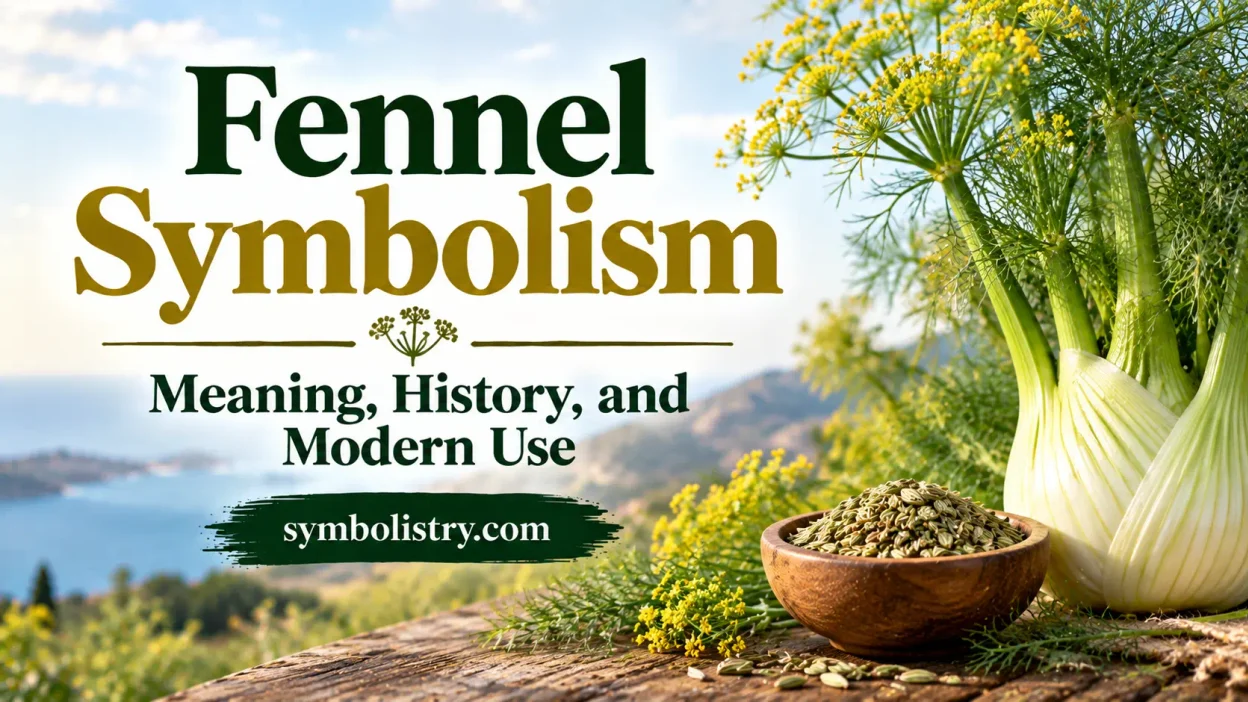
Common fennel, Foeniculum vulgare, is a tall aromatic plant with finely divided leaves, hollow-looking stems, yellow flower clusters, and elongated seeds. Its delicate foliage gives it a soft, almost feathery appearance, while the plant itself can become surprisingly tall and sturdy.
The contrast between its delicate leaves and strong upright growth helps explain why fennel has accumulated several different symbolic associations. It can look fragile while remaining capable of thriving in difficult conditions. That combination lends itself naturally to interpretations involving adaptability and endurance.
Fennel is also unusually versatile. Its bulb, leaves, stalks, and seeds have all been used in food or traditional herbal practices. The plant’s role as both nourishment and medicine has contributed to its association with care and well-being.
That does not mean every historical culture consciously treated fennel as a symbol of “nurturing.” Much of its symbolism developed indirectly from what people actually did with the plant.
The Ancient Roots of Fennel Symbolism
Fennel has an especially strong connection to the ancient Mediterranean world. The Greek word for fennel was associated with marathon, a name connected to a plain where fennel grew abundantly. The plant was familiar enough to appear in both everyday life and mythology.
One of its most important symbolic associations comes from the myth of Prometheus.
According to Hesiodic tradition, Zeus withheld fire from humanity after becoming angry with Prometheus. Prometheus then stole fire and concealed it inside a hollow fennel stalk before bringing it to mortals. The physical properties of giant fennel made the story especially plausible: its dry internal material could carry a smoldering ember without immediately destroying the outer stalk.
This gives fennel an unusual place in symbolism. It is not merely associated with fire itself. It becomes connected with the preservation and transfer of something valuable.
Fire represented warmth, cooking, craftsmanship, and human survival. Fennel therefore became part of a story about knowledge being carried from the divine world to humanity.
Fennel and the Symbolism of Fire
The Prometheus story gives fennel a meaning that goes beyond botanical folklore.
A flame hidden inside a plant stalk can be understood as a metaphor for knowledge carried quietly until it can be used. The fennel stalk becomes a container: something ordinary on the outside protecting something extraordinary within.
This interpretation is particularly useful when fennel appears in artwork inspired by mythology, literature, or classical culture.
It can suggest:
- knowledge preserved through danger
- intelligence used for human benefit
- innovation
- courage to challenge authority
- the transmission of useful knowledge
- civilization and technological progress
These are modern interpretations of an ancient story rather than universally accepted definitions of fennel.
The distinction matters. Someone displaying fennel in a kitchen is usually not making a reference to Prometheus. Someone choosing a fennel stalk in a classical mythology tattoo may be doing exactly that.
Protection, Strength, and Resilience in Folk Tradition
Fennel also developed protective associations in European folk practices.
Historical herbal traditions attributed many practical and medicinal qualities to the plant. Medieval writers praised fennel for uses involving digestion and other bodily complaints, while older folklore connected the plant with protection and physical well-being.
Some folk traditions treated fennel as a protective herb, including customs involving placing or hanging it around the home. These practices belong to folklore rather than established medical science, and they should not be confused with evidence that fennel can literally protect a person from supernatural harm.
Symbolically, however, the pattern is easy to understand: a useful plant that was valued for food, scent, and traditional remedies could become associated with keeping harm away and maintaining household well-being.
That is why fennel may appear in discussions of traditional herbal protection even though contemporary Americans generally encounter it in much more ordinary settings.
Why Fennel Became Associated With Clarity and Vision
One of fennel’s most persistent historical associations concerns eyesight.
Ancient and medieval writers repeated a belief that fennel could benefit vision. Pliny recorded a story that snakes rubbed themselves against fennel after shedding their skins and used the plant to sharpen their sight. Later herbal traditions repeated variations of this idea.
The belief contributed to fennel’s symbolic association with clear sight, perception, and renewed awareness.
This is best understood as historical symbolism rather than medical fact. Modern evidence does not support the old claim that fennel restores lost eyesight.
As a symbol, though, “clear sight” can take on a broader meaning. It may refer to:
- seeing a situation honestly
- gaining perspective
- recognizing something previously overlooked
- learning from experience
- becoming more perceptive
That makes fennel an interesting botanical metaphor for intellectual clarity as well as physical vision.
Fennel in Medieval European Life
During the medieval period, fennel occupied an ordinary but important place in herb gardens. It was valued as a culinary ingredient as well as a traditional medicinal plant.
The ninth-century Benedictine writer Walahfrid Strabo praised fennel in Hortulus, describing its culinary and medicinal qualities. Fennel’s place in monastery gardens reflects how food production, gardening, and traditional medicine were closely connected in medieval European life.
This history gives fennel a different symbolic dimension: practical wisdom.
Unlike a rare flower cultivated primarily for beauty, fennel was useful. It could be grown, harvested, eaten, and incorporated into household remedies.
Its symbolism therefore developed around usefulness rather than purely visual beauty.
That distinction remains relevant today. Fennel can represent the idea that something does not need to be ornamental to be valuable.
Fennel and Nourishment
Because fennel has long been used as a food and flavoring, nourishment is one of its most grounded symbolic interpretations.
The plant’s edible parts connect it with kitchens, gardens, meals, and domestic knowledge. Seeds have traditionally been used as seasoning, while the bulb and leaves are common culinary ingredients in Mediterranean cooking.
Symbolically, fennel can therefore stand for sustenance and everyday care.
In a modern American context, this meaning is particularly natural when fennel appears in:
- kitchen artwork
- botanical prints
- garden designs
- food photography
- herbal illustrations
- recipe books
- culinary tattoos
Here the symbolism does not need to come from mythology. The plant’s actual relationship with food is enough to create meaning.
What Fennel Symbolizes in the United States
There is no single dominant American tradition that assigns fennel one fixed symbolic meaning.
American interpretations are more likely to come from several overlapping sources: European plant folklore, Mediterranean culinary traditions, gardening, herbal culture, mythology, and contemporary botanical aesthetics.
The following comparison shows how context changes the interpretation:
| Context | Meaning in the USA | Common Associations | Notes |
|---|---|---|---|
| Culinary use | Nourishment and hospitality | Food, family, cooking | Usually practical rather than symbolic |
| Mythological art | Knowledge and human ingenuity | Prometheus, fire, civilization | Strong classical connection |
| Herbal imagery | Protection and wellness | Traditional remedies, gardens | Often rooted in folklore |
| Botanical art | Growth and resilience | Nature, simplicity, endurance | Contemporary and personal |
| Tattoo design | Clarity or transformation | Vision, knowledge, renewal | Meaning depends on the wearer |
This flexibility is characteristic of botanical symbolism in contemporary America. A plant may carry historical associations without requiring everyone who sees it to recognize them.
Fennel in Cross-Cultural Traditions
Fennel’s history extends beyond ancient Greece and medieval Europe.
The plant and its seeds were incorporated into medical traditions influenced by Greek, Roman, Arabic, and Persian scholarship. Medieval and Islamic-period writers continued discussing properties attributed to fennel, often drawing on earlier Greek medical traditions.
In African American folk medicine, fennel also appears in documented Gullah herbal traditions from the Sea Islands. The Smithsonian’s catalog of Faith Mitchell’s work on Gullah herbal remedies includes fennel among the plants used in traditional medicine.
These traditions should not be collapsed into one universal meaning. Different communities used fennel according to their own environments, knowledge systems, and cultural practices.
The common thread is its practical value. Fennel repeatedly appears as a useful plant rather than solely as an abstract religious emblem.
The Emotional Meaning of Fennel
When people use plants symbolically today, they often choose them because the plant’s qualities match an experience or personal story.
Fennel can communicate several emotional ideas without requiring a fixed cultural code.
Clarity may appeal to someone entering a new stage of life or trying to make a difficult decision.
Resilience can reflect recovery after hardship.
Nourishment can represent caring for family or maintaining one’s own well-being.
Protection may express a desire for safety and stability.
Knowledge connects especially well with the Prometheus story and may appeal to someone whose identity is shaped by learning, teaching, invention, or intellectual independence.
The emotional symbolism becomes strongest when connected to a specific personal experience rather than treated as a universal definition.
Why Fennel Works in Tattoos and Personal Art
Fennel is an uncommon tattoo subject compared with roses, lilies, snakes, or trees. That relative rarity can make it attractive to people who want botanical imagery with a more specific story.
A fennel tattoo might reference Prometheus and the gift of fire. Another person might choose it because of an interest in herbalism, Mediterranean food, gardening, or botanical illustration.
The plant’s structure also works visually. Its thin leaves and branching flower heads can create a delicate design, while its upright stem gives the composition a strong vertical element.
Possible personal meanings include:
- intellectual curiosity
- resilience
- healing and recovery
- connection to nature
- family nourishment
- personal transformation
- knowledge passed between generations
A fennel tattoo does not automatically mean any one of these things. In contemporary tattoo culture, the wearer’s intention usually matters more than a fixed historical dictionary.
Fennel in Gardens, Food, and Home Decor
Modern American fennel symbolism is often subtle because fennel is primarily encountered as a living plant or food.
In gardens, its tall stems and yellow flower clusters can represent natural growth and seasonal change. Its ability to attract attention without having the conventional appearance of a showy ornamental flower also gives it an understated quality.
In kitchens, fennel is more likely to suggest hospitality, nourishment, and Mediterranean culinary traditions.
In botanical decor, it can evoke simplicity and an appreciation for useful plants.
This is different from Victorian “language of flowers,” in which individual flowers were sometimes assigned specific coded messages. Smithsonian Gardens notes that Victorian flower dictionaries often disagreed with one another, showing that floral meanings were never as fixed as popular summaries sometimes suggest.
Fennel, Religion, and Spiritual Interpretation
Fennel does not have one universally recognized religious meaning in Christianity or another major American religious tradition.
Its historical connections with Christian Europe are more often associated with herbal practice, gardens, fasting, and folk custom than with a central religious doctrine.
Some later folklore also treated fennel as a protective plant, but such practices should be distinguished from official religious teachings.
The Prometheus association is likewise mythological rather than Christian. It comes from ancient Greek tradition and later classical interpretations.
For religious or spiritual artwork, fennel may therefore work as a personal symbol of nourishment, clarity, protection, or knowledge, but those meanings should not be presented as universal religious doctrine.
Common Misunderstandings About Fennel Symbolism
One common mistake is assuming that fennel has a single official symbolic definition.
It does not.
Another is treating every historical herbal belief as scientific fact. Historical claims about fennel improving eyesight, for example, belong to older medical and folkloric traditions and should not be presented as modern medical advice.
It is also misleading to assume that every fennel reference is secretly about Prometheus. The plant has been an ordinary food and herb for a very long time.
Finally, Victorian flower symbolism should not be treated as a universal dictionary. Even historical flower-language guides sometimes assigned different meanings to the same plant or flower.
The safest interpretation is contextual: look at where the fennel appears, what surrounds it, and why someone chose it.
How Fennel’s Meaning Has Changed Over Time
Fennel’s symbolic history is less a straight line than a collection of overlapping traditions.
In ancient Greek mythology, its hollow stalk became associated with carrying fire to humanity. In ancient and medieval herbal traditions, fennel was connected with bodily health, digestion, and eyesight. In European folk practice, it sometimes took on protective associations. In modern America, it is primarily recognized as a culinary herb, vegetable, garden plant, and botanical image.
What has remained consistent is the plant’s usefulness.
Fennel repeatedly appears at the boundary between nature and human knowledge: people grow it, eat it, preserve it, study it, and assign stories to it.
That may explain why its symbolism remains adaptable. It can represent something as practical as nourishment or as literary as the transmission of fire and knowledge.
Frequently Asked Questions
What does fennel symbolize spiritually?
Fennel can be interpreted spiritually as a symbol of protection, clarity, nourishment, and knowledge. These meanings come from different historical traditions rather than from one universally established spiritual doctrine.
What does a fennel tattoo mean?
A fennel tattoo may represent resilience, clarity, healing, botanical appreciation, or knowledge. If the design refers to Prometheus, it can specifically suggest the gift of fire, human ingenuity, or knowledge brought to humanity.
Why is fennel associated with Prometheus?
In Greek tradition, Prometheus concealed stolen fire inside a hollow fennel stalk and carried it to humans. The plant’s ability to hold a smoldering ember helps explain why fennel became part of the story.
Does fennel symbolize healing?
Healing is a reasonable historical association because fennel was widely used in traditional herbal practices. However, historical medicinal use should not be confused with modern medical evidence.
What does fennel symbolize in American culture?
In the United States, fennel has no single standardized symbolic meaning. Its associations are usually drawn from food, gardening, herbal traditions, classical mythology, botanical art, and personal symbolism.
Is fennel a symbol of protection?
Protection is an established theme in some European folk traditions involving fennel. These customs are best understood as folklore rather than evidence that the plant provides supernatural protection.
Is fennel a positive or negative symbol?
Fennel is generally associated with useful and constructive ideas such as nourishment, clarity, resilience, protection, and knowledge. Its meaning can change according to context, particularly when it appears in mythology or personal artwork.
Conclusion
Fennel’s symbolism comes from the plant’s unusual combination of practical usefulness and memorable cultural history. It has served as food and herb, appeared in traditional medicine and folklore, and became part of one of Greek mythology’s most recognizable stories about humanity receiving fire and knowledge.
In contemporary America, fennel symbolism is usually personal rather than standardized. It can suggest clarity, nourishment, resilience, protection, or intellectual curiosity, while a classical reference may point specifically toward Prometheus and the transmission of fire.
Its meaning ultimately depends on context. A fennel plant in a kitchen, garden, tattoo, or mythological illustration can tell a different story—and that flexibility is part of what makes the plant such an interesting symbol.