
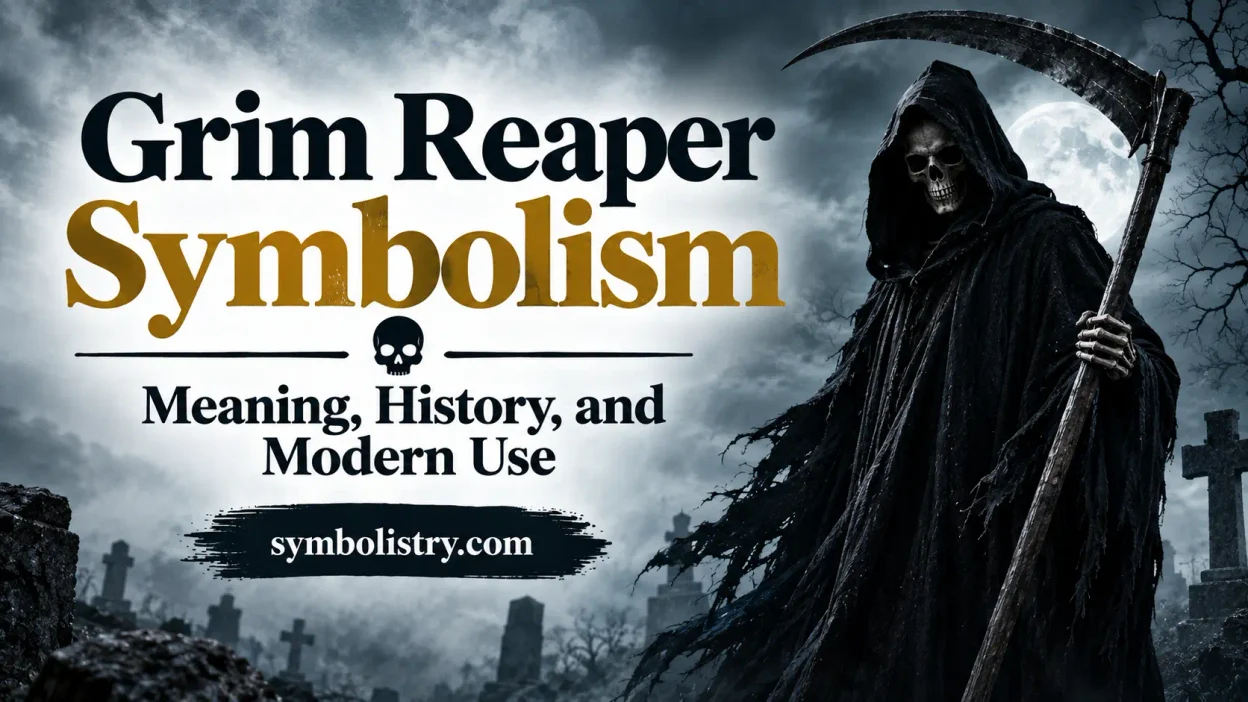
Grim Reaper symbolism commonly centers on death, mortality, and the unavoidable end of human life. The familiar figure—a skeletal person in a dark robe carrying a scythe—turns an abstract idea into a recognizable character, making death easier to represent in art, folklore, humor, and popular culture.
For many Americans, the Grim Reaper is most familiar from Halloween decorations, horror movies, tattoos, illustrations, video games, and dark humor. Yet the image has a longer history than its modern Halloween role suggests. It developed from several European traditions that personified death through skeletons, funerary imagery, the Dance of Death, and reminders that social status cannot protect anyone from mortality.
The figure is therefore more than a frightening costume character. Depending on context, it can represent mortality, the passage of time, fear of death, acceptance of death, equality in the face of mortality, or even an ironic attitude toward danger.
Quick Answer
Grim Reaper symbolism commonly represents death and human mortality in modern American culture, especially in Halloween, horror, tattoos, and dark humor. Historically, the figure developed from European personifications of death and related imagery that emphasized mortality, the passage of time, and the temporary nature of worldly status.
TL;DR
- The Grim Reaper represents death and unavoidable mortality.
- The skeleton connects the figure with physical human mortality.
- The scythe suggests harvesting, cutting life short, and inevitability.
- Medieval European art helped establish personified images of Death.
- Americans commonly associate the Reaper with Halloween and horror.
- Modern tattoos can express mortality, resilience, grief, or dark humor.
What the Grim Reaper Looks Like
The conventional Grim Reaper is usually shown as a human-sized skeleton wearing a long black or dark-colored cloak. A hood often conceals part of the skull, while a large curved scythe rests in one hand.
Each feature contributes to the overall meaning. The skeleton removes individuality and reminds viewers of the physical remains shared by all people. The robe gives Death a human-like presence without making the figure look fully alive. The scythe introduces an agricultural metaphor: just as a farmer cuts crops at harvest, Death eventually “cuts down” human lives.
The imagery is not fixed, however. Artists sometimes depict the Reaper as male, female, ageless, monstrous, humorous, elegant, or almost entirely skeletal. Contemporary versions may carry clocks, hourglasses, flowers, lanterns, or other objects associated with time and mortality.
The Core Meaning: Death and Mortality
The simplest meaning of the Grim Reaper is death.
Unlike a skull by itself, however, the Reaper gives death an imagined agent. A skull represents the condition of being dead; the Reaper represents Death as an active figure who comes for the living.
This distinction helps explain why the image remains so recognizable. Human mortality is abstract, but a hooded figure carrying a scythe can be understood immediately without words.
The symbol can also represent the fact that death cannot be permanently avoided. Wealth, occupation, age, reputation, and social position do not eliminate mortality. In older Dance of Death traditions, Death could appear alongside kings, merchants, laborers, clergy, and ordinary people, reinforcing the idea that everyone ultimately faces the same end.
Ancient and Medieval Roots of Personified Death
The Grim Reaper did not appear fully formed in one historical moment. The modern image developed from several strands of European visual culture.
Medieval Europe frequently represented death through skeletons, corpses, grave imagery, and allegorical figures. One especially important tradition was the Danse Macabre, or Dance of Death. In these scenes, Death interacts with people from different levels of society, often reminding them that earthly position offers no escape from mortality.
Printed versions of the Dance of Death were circulating by the late 15th century. A 1490 French edition published by Guy Marchant is preserved in the collections of the Metropolitan Museum of Art, demonstrating how established the visual tradition had become by that period.
These images were not simply horror illustrations. They could function as moral reminders about the brevity of life, the instability of worldly status, and the importance of preparing for death.
Why the Scythe Became So Important
The scythe is one of the most recognizable parts of the Grim Reaper’s identity.
Its meaning comes from the association between harvesting crops and the ending of human life. Crops are cut when their season has arrived; in the metaphorical version, people are eventually “harvested” by Death.
The scythe also creates a visual connection between nature and mortality. Growing, ripening, harvesting, decay, and renewal are familiar parts of agricultural life. Turning the harvesting tool into Death’s weapon made mortality easier to visualize.
Over time, the scythe became so strongly associated with personified Death that modern artists can sometimes communicate the entire concept simply by drawing the curved blade.
What the Skeleton Represents
The skeleton has a particularly direct relationship with mortality because it shows what remains after the body has decomposed.
Earlier European memento mori traditions used skulls, bones, skeletons, and other reminders of physical impermanence. The skeleton therefore carries meanings that go beyond fear. It can represent the temporary nature of physical existence and the fact that death eventually strips away outward differences between people.
This is one reason skeleton imagery appears in both serious and playful contexts today. A skeleton on a cemetery monument can suggest remembrance, while a cartoon skeleton at a Halloween party may simply signal seasonal entertainment.
The same basic image can therefore communicate grief, warning, humor, rebellion, or celebration depending on its setting.
Grim Reaper Symbolism in the United States
In the United States, the Grim Reaper is strongly connected with popular representations of Halloween and horror. American Halloween culture frequently uses skeletons, ghosts, cemeteries, witches, monsters, and other death-related imagery as decorations and costumes. The Library of Congress describes Halloween as one of the most popular holidays in contemporary America, with longstanding traditions involving supernatural imagery and costumes.
The American interpretation is also shaped by entertainment. Horror films, television, comic books, music, video games, advertising, and cartoons have repeatedly adapted the Reaper into different roles.
Sometimes the character is terrifying. Sometimes he is absurd. Sometimes he is a neutral supernatural figure simply performing the job of collecting the dead.
That flexibility has helped the image survive outside strictly religious or funerary contexts.
How Americans Commonly Interpret the Symbol
The meaning of the Grim Reaper varies considerably according to context.
| Context | Common U.S. Meaning | Typical Associations | Tone |
|---|---|---|---|
| Halloween | Death and the supernatural | Costumes, haunted houses, decorations | Playful or frightening |
| Horror media | Threat or impending death | Villains, curses, supernatural danger | Dark |
| Tattoo culture | Mortality or personal philosophy | Life, death, survival, remembrance | Personal |
| Dark humor | Acceptance or mockery of death | Memes, jokes, entertainment | Ironic |
| Memorial imagery | Mortality and remembrance | Graves, skulls, loss | Somber |
There is no single American interpretation. A person choosing a Grim Reaper tattoo may be expressing something very different from a homeowner putting a Reaper decoration beside a pumpkin for Halloween.
Grim Reaper Imagery and Halloween
Halloween is probably the setting in which most Americans encounter the Grim Reaper today.
The figure fits naturally into a holiday that incorporates ghosts, skeletons, cemeteries, costumes, supernatural stories, and playful encounters with frightening subjects. Halloween itself has a complicated history involving older seasonal traditions, Christian observances, and later American customs.
In modern American neighborhoods, the Reaper may appear as a plastic lawn decoration, inflatable figure, hanging prop, animated display, or costume.
This use changes the emotional function of the symbol. Death becomes something people can stage, decorate, joke about, and temporarily confront. The Reaper does not necessarily represent actual grief in this setting. Often, he represents the theatrical side of fear.
Emotional and Psychological Associations
The Grim Reaper can evoke fear because it gives a recognizable form to one of the most difficult subjects humans face.
For some people, the image creates anxiety about dying or losing someone. For others, it provides a way to acknowledge mortality without discussing it directly.
This difference matters. A person wearing a Grim Reaper shirt may be expressing an interest in horror rather than a personal fear of death. A person choosing the figure for a memorial tattoo may have a much more intimate reason.
The symbol can also communicate acceptance. Seeing death as a universal part of life is different from celebrating death itself. In this context, the Reaper can represent an awareness that time is limited and that life has an endpoint.
Grim Reaper Tattoos and Personal Identity
The Grim Reaper is a common choice for tattoo imagery because it is visually distinctive and easy to personalize.
Some tattoos pair the figure with clocks or hourglasses to emphasize time. Others combine it with roses, crosses, names, dates, skulls, ravens, flames, or landscapes. These additions can substantially change the message.
A Reaper with a memorial date may refer to a deceased person. A Reaper surrounded by flowers can create a contrast between life and death. A cartoon-style Reaper may communicate dark humor rather than mourning.
For some people, the tattoo represents survival after a dangerous period or a reminder to appreciate life. For others, it simply reflects an interest in gothic art, horror, heavy music, fantasy, or macabre aesthetics.
The image should therefore be interpreted according to the surrounding design and the wearer’s stated intention rather than assigned one universal meaning.
Religious and Spiritual Interpretations
The Grim Reaper is often mistaken for a universal religious figure, but that interpretation is too broad.
The familiar hooded skeleton with a scythe is primarily a cultural and artistic personification of death rather than a single authoritative figure shared by all major religions. Religious traditions have their own teachings and imagery concerning death, judgment, the afterlife, angels, demons, ancestors, or divine authority.
Christian European art contributed substantially to medieval and early modern representations of mortality, including memento mori and Dance of Death imagery. Yet the modern Grim Reaper should not automatically be treated as a Christian doctrine or theological being. The Library of Congress classifies the Grim Reaper as a symbolic character under personification of Death, reflecting its broader status as an allegorical figure.
That distinction is important when discussing the symbol respectfully across religious contexts.
The Grim Reaper Compared With Other Death Symbols
The Reaper is only one way cultures represent death.
A skull usually emphasizes physical mortality. An hourglass can emphasize passing time. A cemetery can represent burial and remembrance. A raven may be used in some artistic traditions as an ominous or death-associated animal. A funeral veil can suggest mourning and separation.
The Grim Reaper combines several of these ideas into a single character.
His skeleton represents the dead body. His scythe represents cutting or harvesting. His cloak creates an otherworldly appearance. His movement toward the viewer suggests that death is not merely a distant condition but an eventual event.
This combination explains why the figure is so efficient as visual shorthand.
Cross-Cultural Death Imagery
Death is represented very differently across cultures, so the Grim Reaper should not be treated as a universal model.
European traditions contributed strongly to the skeleton-and-scythe image. Meanwhile, other cultures have their own figures and practices surrounding death, ancestors, mourning, and the afterlife.
For example, Día de los Muertos traditions in Mexico and Mexican American communities use skull imagery, but the cultural meaning is not simply equivalent to the Grim Reaper. Día de los Muertos includes remembrance of deceased loved ones and can use colorful, celebratory imagery rather than presenting death solely as frightening.
This difference illustrates an important point: a skull does not automatically mean fear, and death imagery does not automatically mean horror. Cultural context determines much of the meaning.
The Reaper in American Popular Culture
American popular culture has repeatedly reinvented the Grim Reaper.
In cartoons, the character may be awkward or comedic. In horror stories, he may function as an unstoppable pursuer. In fantasy, he may become a supernatural worker with rules, personality, or even a sense of humor.
Political cartoons and editorial illustrations have also used the Reaper as a metaphor for disasters, dangerous industries, social problems, and public anxieties. A Library of Congress illustration from 1883, for example, depicts the Grim Reaper in a satirical scene concerning insurance and disasters. Another early-20th-century cartoon portrays him as a steamboat captain.
These examples show that the symbol has never been limited to literal death. Artists have long used the Reaper to personify danger and criticize institutions or behavior.
Dark Humor and the Modern Meaning of Death
Modern American culture often uses dark humor to make uncomfortable subjects easier to discuss.
The Grim Reaper works particularly well for this purpose because his appearance is instantly recognizable. A meme showing the Reaper waiting outside an office, for example, can turn anxiety about work or exhaustion into a joke. A cartoon version can make mortality absurd rather than frightening.
This does not mean the underlying subject has become meaningless. Humor can create distance from difficult realities while still acknowledging them.
The Reaper therefore occupies an unusual cultural space: he can be terrifying in one context and ridiculous in another without losing his basic identity.
Common Misunderstandings About the Grim Reaper
One common misunderstanding is that the Grim Reaper has a single ancient origin. The modern figure is better understood as a later combination of several established death symbols and traditions.
Another misconception is that every appearance of a Reaper represents evil. Death and evil are not necessarily the same concept. The figure often personifies mortality rather than moral wrongdoing.
It is also inaccurate to assume that every skull-and-scythe image has a religious meaning. In contemporary America, the imagery may simply indicate Halloween, horror, gothic fashion, tattoo culture, or dark comedy.
Finally, the symbol should not automatically be interpreted as a desire for death. Personal context matters, particularly when the imagery appears in clothing, artwork, or tattoos.
How the Symbol Has Changed Over Time
The meaning of personified Death has shifted considerably.
In medieval and early modern Europe, Dance of Death imagery could remind viewers of mortality, social equality in death, and religious preparation. Later artists increasingly adapted death imagery for satire, literature, political commentary, and popular entertainment.
By the 19th and 20th centuries, the Grim Reaper had become recognizable enough to function as a general visual metaphor. Newspapers and artists could use the figure to represent war, accidents, disease, financial danger, or other threats without needing lengthy explanations.
Today, the Reaper exists simultaneously as a traditional symbol of mortality and a pop-culture character. That dual identity explains why the same image can appear on a serious memorial tattoo, a horror poster, and a plastic Halloween lawn decoration.
FAQ
What does the Grim Reaper symbolize?
The Grim Reaper primarily symbolizes death, mortality, and the unavoidable end of life. Depending on context, the figure can also represent passing time, fear, acceptance of mortality, danger, or dark humor.
What does a Grim Reaper tattoo mean?
A Grim Reaper tattoo can represent mortality, remembrance, survival, personal philosophy, or an interest in gothic and horror aesthetics. Its meaning often changes according to accompanying elements such as clocks, flowers, names, dates, or religious imagery.
Is the Grim Reaper a religious figure?
The familiar Grim Reaper is not a single official religious figure shared across major faiths. The modern image developed through European artistic traditions that personified death, including medieval Dance of Death and memento mori imagery.
Why does the Grim Reaper carry a scythe?
The scythe connects death with harvesting. Crops are cut when their season ends, creating a metaphor for human lives eventually being “cut down” by death.
Is the Grim Reaper always a symbol of evil?
No. The figure usually represents death rather than evil itself. In modern culture, the Reaper may appear as frightening, neutral, comedic, philosophical, or even satirical depending on the context.
Why is the Grim Reaper associated with Halloween?
Halloween commonly uses skeletons, ghosts, cemeteries, supernatural characters, and other imagery connected with death and the unknown. The Grim Reaper fits this visual tradition and has become a familiar American Halloween decoration and costume.
Does the Grim Reaper symbolize fear of death?
It can, but that is not its only meaning. The figure can also symbolize acceptance of mortality, awareness that life is temporary, remembrance of someone who died, or a humorous way of confronting an uncomfortable subject.
Conclusion
The Grim Reaper is one of the clearest visual representations of mortality in Western popular culture. His skeleton represents the physical reality of death, while the scythe turns the agricultural idea of harvesting into a metaphor for the end of human life. Medieval Dance of Death imagery helped establish the broader tradition of personifying Death, while later artists, newspapers, entertainers, and American popular culture continually adapted it.
In the United States, Grim Reaper symbolism now extends far beyond solemn reflections on mortality. It appears in Halloween decorations, horror entertainment, tattoos, fashion, satire, memes, and dark humor, with meanings ranging from fear and mourning to acceptance and irony.
The enduring usefulness of the figure comes from its simplicity: a skeleton with a scythe can communicate an idea that otherwise takes many words to explain. Death may be difficult to discuss, but the Grim Reaper gives that reality a recognizable face.
[…] See also Grim Reaper Symbolism: Meaning, History, and Modern Use […]